US Gaming Start-up Investment: 2026 High-Growth Opportunities

The gaming industry, once a niche entertainment sector, has evolved into a global powerhouse, consistently outperforming traditional media and entertainment segments. As we approach 2026, the United States stands at the forefront of this revolution, boasting a vibrant ecosystem of innovative start-ups poised for exponential growth. For discerning investors, understanding the landscape of gaming start-up investment in the US is not just an opportunity; it’s a strategic imperative. This comprehensive guide will navigate the burgeoning sectors with projected growth rates exceeding 20%, offering an unparalleled look into where smart money is heading.
The US gaming market is a behemoth, driven by technological advancements, increasing consumer engagement, and novel business models. From immersive virtual realities to sophisticated AI-driven narratives and the disruptive potential of blockchain, the avenues for high-yield gaming start-up investment are diversifying rapidly. Investors looking to capitalise on this dynamic market must identify key trends, evaluate potential risks, and understand the unique characteristics of each emerging segment. Our focus is on identifying those hidden gems and future titans that promise not just significant returns but also shape the future of interactive entertainment.
The Exploding Market: Why US Gaming Start-ups are Prime for Investment
The sheer scale and resilience of the US gaming market make it an attractive proposition. Valued at hundreds of billions of dollars, it continues its upward trajectory, fueled by a growing player base and increasing monetisation strategies. What makes US gaming start-ups particularly appealing for gaming start-up investment is their access to a robust venture capital ecosystem, a highly skilled talent pool, and a culture of innovation that encourages disruptive technologies.
Technological leaps in computing power, internet infrastructure, and graphics processing have lowered barriers to entry for independent developers, fostering a fertile ground for new ideas. Furthermore, the COVID-19 pandemic significantly accelerated gaming adoption, solidifying its role as a mainstream entertainment form. This expanded audience, coupled with evolving platforms and content consumption habits, has created unprecedented demand for novel gaming experiences.
For investors, this translates into a market ripe with potential for substantial returns. Early-stage investments in promising start-ups can yield significant multiples as these companies mature and capture market share. However, identifying these opportunities requires a keen understanding of the technological and cultural shifts driving the industry.
Emerging Sectors with 20%+ Growth Potential for 2026
To pinpoint the most lucrative opportunities for gaming start-up investment, we must look beyond traditional gaming and delve into the bleeding edge of innovation. Several sectors are poised for explosive growth by 2026, driven by technological breakthroughs and shifting consumer preferences.
Extended Reality (XR) Gaming: Virtual, Augmented, and Mixed Realities
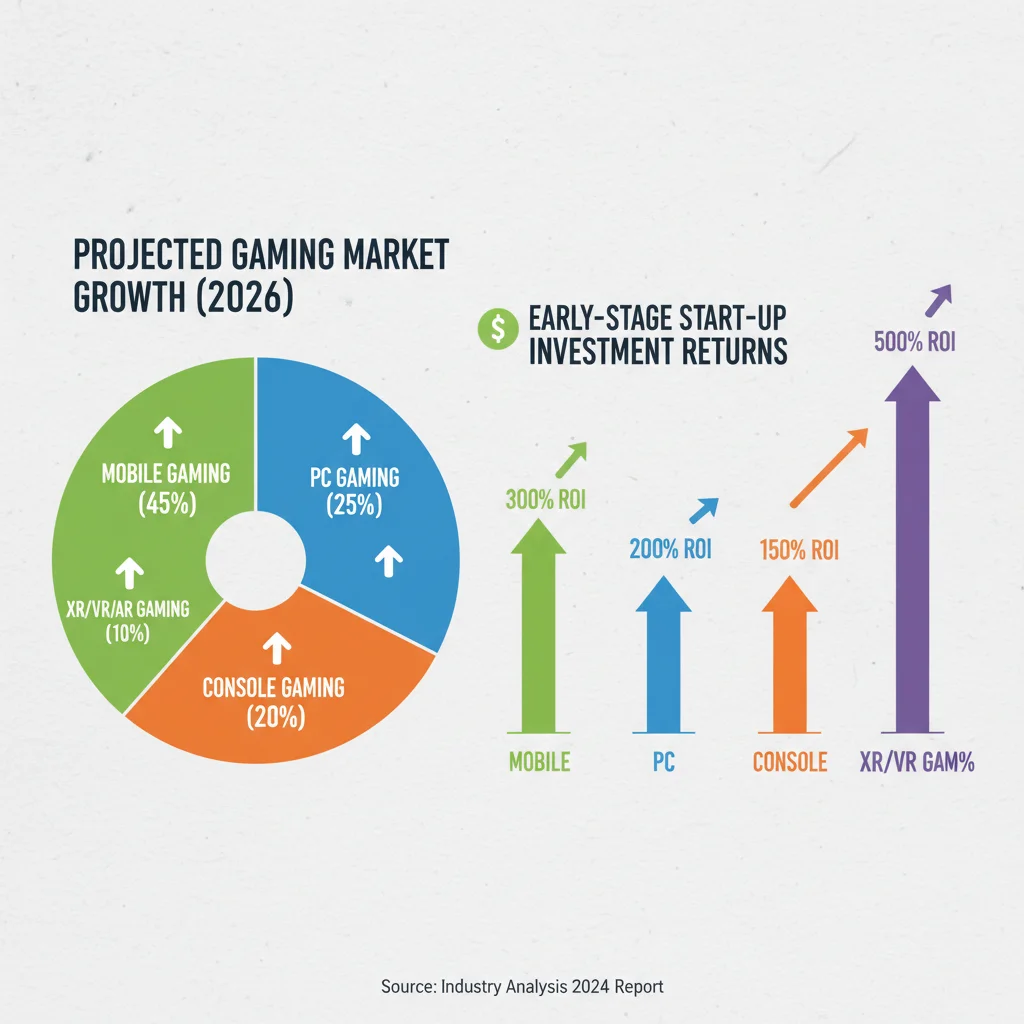
XR gaming, encompassing Virtual Reality (VR), Augmented Reality (AR), and Mixed Reality (MR), is no longer a futuristic concept but a rapidly materialising reality. With advancements in hardware – lighter headsets, improved optics, and more powerful processing – and sophisticated software development, XR is set to redefine immersive entertainment. Projections indicate that the XR gaming market could see annual growth rates well over 25% in the coming years, making it a prime candidate for gaming start-up investment.
- VR Gaming: While still facing adoption challenges, VR is gaining traction with standalone headsets offering unparalleled immersion. Start-ups focusing on unique content, social VR experiences, and haptic feedback technologies are particularly attractive.
- AR Gaming: More accessible due to its smartphone integration, AR gaming overlays digital content onto the real world. Think beyond Pokémon GO; innovative AR start-ups are exploring educational games, interactive storytelling, and location-based entertainment that blends the physical and digital.
- MR Gaming: The most advanced form of XR, MR seamlessly blends real and virtual worlds, allowing for interaction with both. Though nascent, start-ups developing MR experiences for entertainment, training, and simulation hold immense long-term potential.
Investment in XR start-ups should consider their proprietary technology, content pipeline, and ability to address user comfort and accessibility. The convergence of AI with XR, creating intelligent virtual characters and dynamic environments, further amplifies this sector’s appeal.
Blockchain Gaming and Play-to-Earn (P2E) Models
Blockchain technology is revolutionising the gaming industry by introducing true digital ownership, transparent economies, and new monetisation models. Play-to-Earn (P2E) games, where players can earn cryptocurrency and NFTs (Non-Fungible Tokens) through gameplay, have garnered significant attention, with some analysts predicting a compound annual growth rate exceeding 20% for this segment.
- NFT Integration: Start-ups leveraging NFTs for in-game assets, character ownership, and unique collectibles are creating new value propositions for players and investors alike.
- Decentralised Autonomous Organisations (DAOs): Gaming DAOs empower players with governance rights, fostering community ownership and engagement. Investments in platforms facilitating such decentralised game development and management are promising.
- Interoperable Gaming: The vision of assets being transferable across different games and metaverses is still in its early stages, but start-ups building foundational technologies for interoperability will be crucial.
While the blockchain gaming space has seen volatility, the underlying technology’s ability to create verifiable scarcity and empower players presents a paradigm shift. Investors must exercise due diligence, focusing on projects with sustainable economic models, strong community engagement, and clear utility for their blockchain implementation.
AI-Driven Gaming Experiences and Development Tools
Artificial Intelligence (AI) is permeating every aspect of game development and player experience, from procedural content generation to dynamic difficulty adjustment and hyper-realistic NPC behaviour. The market for AI in gaming is projected to grow substantially, with bespoke AI solutions for game development being a particularly hot area for gaming start-up investment.
- Procedural Generation: AI-powered tools that can generate vast, unique game worlds, quests, and narratives can dramatically reduce development costs and increase replayability.
- Adaptive AI: Start-ups creating AI that learns from player behaviour to offer personalised challenges, storylines, and even character interactions are enhancing immersion and engagement.
- AI for Game Testing and Optimisation: AI can automate testing processes, identify bugs, and optimise game performance, significantly streamlining the development cycle.
- AI-Powered Content Creation: Tools that assist artists and designers in generating assets, animations, and soundscapes using AI can democratise game development and accelerate production.
Investing in AI gaming start-ups means looking for companies with strong research and development capabilities, unique algorithms, and a clear vision for how AI enhances the gaming experience or streamlines its creation.
The Metaverse: The Grand Convergence of Gaming and Digital Life
While not a single sector, the metaverse represents the ultimate convergence of many emerging technologies, with gaming serving as its primary gateway. The vision of a persistent, interconnected, and interactive virtual world where users can socialise, work, play, and transact is driving massive investment and innovation. Start-ups building foundational metaverse infrastructure, tools, and experiences are attracting significant capital.
- Metaverse Platforms: Investment in platforms that aim to be the ‘operating systems’ of the metaverse, offering interoperability and robust development tools.
- Avatar and Digital Identity: Companies creating highly customisable avatars, digital fashion, and identity verification solutions crucial for a thriving metaverse.
- Spatial Computing and 3D Tools: Start-ups developing advanced 3D modelling, rendering, and spatial computing technologies essential for building rich metaverse environments.
The metaverse is a long-term play, but early gaming start-up investment in this space could yield monumental returns as the ecosystem matures. Identifying start-ups with a clear value proposition within the metaverse, rather than just buzzwords, is key.
Cloud Gaming and Streaming Services: The Future of Accessibility
Cloud gaming eliminates the need for expensive hardware, streaming games directly to various devices. This democratises access to high-fidelity gaming experiences and expands the potential player base significantly. While dominated by large tech companies, innovative start-ups are finding niches within this sector, particularly in:
- Niche Content Streaming: Focusing on specific genres or indie titles that might not be picked up by larger platforms.
- Edge Computing for Gaming: Developing solutions to reduce latency and improve performance by bringing computing closer to the user.
- Subscription Model Innovations: Creating new and flexible subscription models or ad-supported streaming options.
The growth in cloud gaming is driven by improved internet infrastructure and the desire for frictionless access to content. Start-ups that can innovate on the technical or business model front within this space offer compelling gaming start-up investment opportunities.
Esports Infrastructure and Analytics: Professional Gaming’s Backbone
Esports continues its explosive growth, drawing massive audiences and generating significant revenue. Beyond the professional teams and tournaments, there’s a growing need for robust infrastructure and sophisticated analytics. This sector offers diverse gaming start-up investment opportunities:
- Tournament Platforms: Start-ups building scalable and secure platforms for amateur and professional esports tournaments.
- Performance Analytics: Companies developing AI-driven tools to analyse player performance, strategies, and team dynamics for training and scouting.
- Fan Engagement Technologies: Innovations in interactive streaming, fan-created content platforms, and community management tools.
- Esports Education and Coaching: Platforms offering structured learning and coaching for aspiring esports professionals.
Investing in esports infrastructure is a way to capitalise on the overall growth of professional gaming, providing essential services that support the entire ecosystem.
Key Considerations for Gaming Start-up Investment in 2026
While the opportunities are vast, successful gaming start-up investment requires careful due diligence and a nuanced understanding of the market. Here are crucial factors to consider:
Team and Vision
The strength of the founding team is paramount. Look for experienced leaders with a proven track record in game development, technology, or entrepreneurship. A clear, compelling vision for their product and market fit is essential. Evaluate their ability to execute, adapt to market changes, and attract top talent.
Proprietary Technology and Intellectual Property (IP)
In a competitive landscape, start-ups with unique technology, patented innovations, or strong intellectual property are more likely to succeed. This could be a novel game engine, a unique AI algorithm, a new blockchain implementation, or a distinctive art style and narrative.
Market Size and Target Audience
Assess the total addressable market (TAM) for the start-up’s product. Is it a niche market with high potential, or a broad market with significant competition? Understand their target audience and how effectively they plan to reach and retain them. A clear go-to-market strategy is vital.
Monetisation Strategy and Business Model
Beyond the hype, a sustainable business model is critical. Evaluate how the start-up plans to generate revenue – through game sales, subscriptions, in-app purchases, advertising, or novel P2E mechanics. Look for models that are scalable and resilient to market fluctuations.
Competitive Landscape and Differentiation
Every start-up operates within a competitive environment. Understand who their competitors are, both direct and indirect, and how the start-up differentiates itself. What is their unique selling proposition (USP)? How will they achieve and maintain a competitive advantage?
Scalability and Growth Potential
For a 20%+ growth projection to be realised, the start-up must have a clear path to scalability. Can their technology and business model accommodate rapid user growth? Do they have a roadmap for future development and expansion into new markets or platforms?
Regulatory and Ethical Considerations
Especially in nascent sectors like blockchain gaming and AI, regulatory landscapes are still evolving. Consider the potential impact of future regulations on the start-up’s operations and business model. Ethical considerations, particularly around data privacy, addictive mechanics, and responsible AI, are also increasingly important.

Navigating Risks and Maximising Returns in Gaming Start-up Investment
Investing in start-ups always carries inherent risks, and the fast-paced gaming industry is no exception. However, with careful risk management and strategic foresight, these risks can be mitigated, and returns maximised.
Due Diligence is Non-Negotiable
Thorough due diligence is the cornerstone of successful gaming start-up investment. This includes financial analysis, market research, technical assessments, and legal review. Engage experts where necessary to gain a comprehensive understanding of the start-up’s potential and pitfalls.
Portfolio Diversification
Avoid putting all your eggs in one basket. Diversify your gaming start-up investment across different sectors (XR, blockchain, AI), business models, and stages of development. This strategy helps to cushion against individual project failures and captures broader market growth.
Stay Informed and Adaptable
The gaming industry evolves at a breakneck pace. Continuous learning about new technologies, market trends, and consumer behaviours is crucial. Be prepared to adapt your investment thesis as the landscape shifts.
Leverage Industry Networks
Connect with other investors, industry veterans, and entrepreneurs. These networks can provide invaluable insights, deal flow, and co-investment opportunities. Attending industry conferences and demo days can also be highly beneficial.
Focus on Long-Term Vision
While some start-ups might offer quick wins, the most significant returns often come from long-term investments in companies that are building foundational technologies or creating truly disruptive experiences. Patience is a virtue in venture capital.
Success Stories and What They Teach Us
Looking at past successes in gaming start-up investment can provide valuable lessons. Companies like Oculus (acquired by Meta), Unity Technologies (IPO), and Epic Games (Fortnite’s success) demonstrate the immense potential. Common threads among these successes include:
- Innovation: They introduced genuinely new technologies or experiences.
- Strong Leadership: Visionary founders capable of executing their plans.
- Scalability: Products capable of reaching a massive global audience.
- Community Building: Fostering strong, engaged user communities.
- Adaptability: Willingness to pivot and evolve with market demands.
These principles remain relevant for evaluating the next wave of US gaming start-ups.
The Regulatory Landscape and Ethical Considerations
As the gaming industry expands into new technological frontiers, so does the scrutiny from regulators and the public. Investors must be aware of the evolving regulatory landscape, particularly concerning data privacy (e.g., GDPR, CCPA), consumer protection, and financial regulations impacting blockchain and NFT projects.
Ethical considerations are also becoming increasingly important. Start-ups that prioritise responsible game design, address issues like addiction, promote diversity and inclusion, and ensure fair monetisation practices are not only more likely to build sustainable businesses but also attract socially conscious investors. Companies with robust policies around user data, content moderation, and child safety will have a significant competitive advantage and reduce regulatory risks.
For example, in the play-to-earn space, clarity on how digital assets are classified (securities vs. commodities) and the tax implications for players and platforms remain fluid. Start-ups that proactively engage with legal counsel and design their systems with future compliance in mind will be better positioned for long-term success. Similarly, AI in gaming raises questions about bias in algorithms, the ethical use of player data, and the potential for deepfakes or manipulative content. Investors should favour start-ups that demonstrate a commitment to ethical AI development and transparency.
The Role of Strategic Partnerships and Acquisitions
The US gaming market is also characterised by a dynamic landscape of strategic partnerships and acquisitions. Large publishers and tech giants are constantly looking to acquire innovative start-ups to bolster their IP, talent pool, or technological capabilities. For investors, this presents a significant exit strategy.
Start-ups that develop unique technology, cultivate a strong user base, or create compelling content are often prime targets for acquisition. Understanding the potential for strategic partnerships with larger players or eventual acquisition by a major industry player can be a key factor in evaluating a gaming start-up investment. Conversely, start-ups that can forge strategic alliances with other companies – for distribution, co-development, or cross-promotion – can accelerate their growth and market penetration.
These partnerships can take many forms, from integrating a start-up’s AI tools into an established game engine to collaborating on a metaverse project with a major brand. Investors should assess a start-up’s ability to form and leverage such relationships as a sign of its strategic acumen and potential for future success.
Conclusion: Seizing the Future of Gaming with Strategic Investment
The US gaming industry is a fertile ground for innovation and significant returns. By focusing on emerging sectors like XR gaming, blockchain and P2E models, AI-driven experiences, cloud gaming, and esports infrastructure, investors can position themselves to capitalise on the industry’s projected 20%+ growth by 2026. Successful gaming start-up investment hinges on rigorous due diligence, a deep understanding of technological trends, and a commitment to long-term vision.
As the lines between gaming, social media, and digital life continue to blur, the opportunities for disruptive start-ups in the interactive entertainment space will only multiply. For those willing to navigate the complexities and embrace the innovation, the rewards in the US gaming market promise to be substantial. The future of entertainment is interactive, immersive, and increasingly intelligent – and the time to invest is now.