Mobile Gaming Revenue 2026: A $150 Billion Market Forecast
Mobile Gaming’s 2026 Revenue Projections: A $150 Billion Market Driven by 6 Key Titles
The landscape of entertainment is constantly evolving, and at its forefront, mobile gaming stands as a titan. What was once considered a casual pastime has transformed into a multi-billion-dollar industry, captivating billions of players worldwide. As we cast our gaze towards 2026, the projections are nothing short of astounding: the mobile gaming market is anticipated to surge to an incredible $150 billion. This colossal figure isn’t just a number; it represents a dynamic ecosystem fueled by technological advancements, innovative game design, and an ever-expanding player base. Understanding this trajectory requires a deep dive into the underlying forces at play, the strategic moves of industry giants, and the captivating power of specific titles that are setting new benchmarks for engagement and monetization.
The growth of mobile gaming revenue is not a sudden phenomenon but a culmination of years of innovation and strategic development. From simple puzzle games to complex augmented reality experiences, the spectrum of mobile games has broadened immensely. This expansion has been supported by significant improvements in smartphone technology, faster internet speeds, and the increasing accessibility of mobile devices across various demographics. The convenience of gaming on the go, combined with the often free-to-play model that lowers the barrier to entry, has made mobile gaming an indispensable part of daily life for countless individuals. This article will meticulously explore the factors contributing to this unprecedented growth, identify the key titles driving this revenue, and offer insights into what the future holds for this booming sector.
As we delve into the intricacies of the mobile gaming market, it’s essential to recognize that this forecast isn’t merely speculative. It’s built upon robust data, market trends, and the continued innovation that defines the industry. The $150 billion projection for 2026 underscores not only the financial might of mobile gaming but also its cultural impact and its capacity to redefine entertainment. Join us as we unravel the secrets behind this monumental growth and discover the games that are poised to dominate this lucrative landscape.
The Unstoppable Rise of Mobile Gaming Revenue
The journey of mobile gaming from its nascent stages to a projected $150 billion market by 2026 is a testament to its unparalleled adaptability and widespread appeal. Initially, mobile games were simplistic, often pre-installed on feature phones, offering basic entertainment. The advent of smartphones and app stores, however, revolutionized the industry, transforming mobile devices into powerful gaming platforms. This shift opened the floodgates for developers to experiment with more complex mechanics, richer graphics, and engaging narratives, attracting a diverse global audience.
Several key factors underpin this phenomenal growth in mobile gaming revenue. Firstly, the sheer ubiquity of smartphones has created an enormous addressable market. Billions of people globally own a smartphone, making mobile gaming accessible to a broader demographic than console or PC gaming. This widespread adoption has democratized gaming, allowing individuals from all walks of life to participate, often at no initial cost.
Secondly, the free-to-play (F2P) model, coupled with in-app purchases (IAPs), has proven to be an incredibly effective monetization strategy. While the core game is free, players can spend money on virtual items, cosmetic upgrades, battle passes, or to accelerate progress. This model lowers the entry barrier, attracting a massive player base, a small percentage of whom become high-spending ‘whales,’ driving significant revenue. The psychological hooks embedded in these F2P models, such as daily rewards, limited-time offers, and competitive leaderboards, keep players engaged and incentivized to spend.
Thirdly, technological advancements have continually pushed the boundaries of what’s possible on mobile devices. More powerful chipsets, high-resolution displays, and improved battery life have enabled developers to create console-quality experiences on smartphones and tablets. Innovations in cloud gaming, augmented reality (AR), and artificial intelligence (AI) are further enhancing mobile gaming experiences, offering immersive and interactive gameplay that was once unimaginable.
Furthermore, the social aspect of mobile gaming has been a significant driver of engagement and revenue. Multiplayer titles, guild systems, and social integration features allow players to connect with friends and strangers, fostering communities and encouraging sustained play. The competitive nature of many mobile games, often supported by esports initiatives, also adds another layer of engagement, drawing in players eager to test their skills against others.
The COVID-19 pandemic also played an unexpected role in accelerating mobile gaming’s growth. With lockdowns and increased time spent at home, many turned to mobile games for entertainment, connection, and stress relief. This surge in engagement introduced mobile gaming to new audiences and solidified its position as a primary form of entertainment for many existing players. While the pandemic’s direct impact has waned, the habits formed during that period have largely persisted, contributing to the sustained growth trajectory.
Finally, the strategic investments by major tech companies and traditional gaming publishers into the mobile sector underscore its importance. Companies like Tencent, Sony, Microsoft, and Nintendo are increasingly focusing on mobile adaptations of their popular franchises or developing original mobile-first titles, recognizing the immense potential for revenue and audience reach. This influx of capital and expertise ensures continued innovation and high-quality game development, further fueling the mobile gaming revenue boom.
Key Revenue Drivers: Beyond Just In-App Purchases
While in-app purchases (IAPs) remain the cornerstone of mobile gaming revenue, the projected $150 billion market by 2026 is also being propelled by a diversified ecosystem of monetization strategies. Understanding these drivers is crucial to grasping the full scope of the industry’s financial success. It’s not just about selling virtual goods; it’s about creating engaging experiences that encourage diverse forms of spending and participation.
One significant driver is in-game advertising. Many free-to-play games incorporate ads strategically, offering players rewards for watching video ads, or displaying banner ads. This model allows developers to monetize non-spending players, contributing a substantial portion to overall revenue, especially for casual games with massive user bases. The sophistication of ad tech has also improved, allowing for more targeted and less intrusive advertising experiences, which can be more palatable to players.
Subscription models are also gaining traction, offering players premium content, ad-free experiences, or exclusive benefits for a recurring fee. Services like Apple Arcade and Google Play Pass provide access to a curated library of games without IAPs or ads, appealing to players who prefer a premium, uninterrupted gaming experience. Individual games are also experimenting with battle passes and monthly subscriptions that unlock a stream of content and rewards, fostering long-term engagement and predictable revenue streams.
The rise of esports and competitive gaming on mobile platforms is another burgeoning revenue stream. While not directly tied to game sales, esports events generate revenue through sponsorships, advertising, merchandise sales, and ticket sales for live events. Games that foster a strong competitive scene attract dedicated players who are more likely to invest in the game, whether through IAPs for competitive advantage (or perceived advantage) or to support their favorite teams and creators. This ecosystem creates a halo effect, drawing more attention and players to the games.
Brand partnerships and collaborations are also becoming increasingly common. Mobile game developers are partnering with major brands from various industries, including fashion, music, and film, to create in-game events, cosmetic items, or character crossovers. These collaborations not only generate direct revenue through exclusive content but also serve as powerful marketing tools, expanding the game’s reach to new audiences and enhancing its cultural relevance.
Furthermore, the growing sophistication of data analytics and personalization plays a pivotal role. Developers are leveraging vast amounts of player data to understand behaviors, preferences, and spending habits. This allows them to tailor content, offers, and even game mechanics to individual players, maximizing engagement and monetization potential. Personalized offers, dynamic pricing, and A/B testing of features are common practices that optimize revenue generation.
Finally, the sheer volume of content updates and live service models ensures sustained engagement and spending. Mobile games are rarely static; they continuously evolve with new levels, characters, events, and features. This constant stream of fresh content keeps the player base active and provides ongoing opportunities for monetization, transforming games into long-term entertainment platforms rather than one-off purchases. This commitment to live services fosters a loyal community and encourages players to continue investing their time and money into their favorite titles.
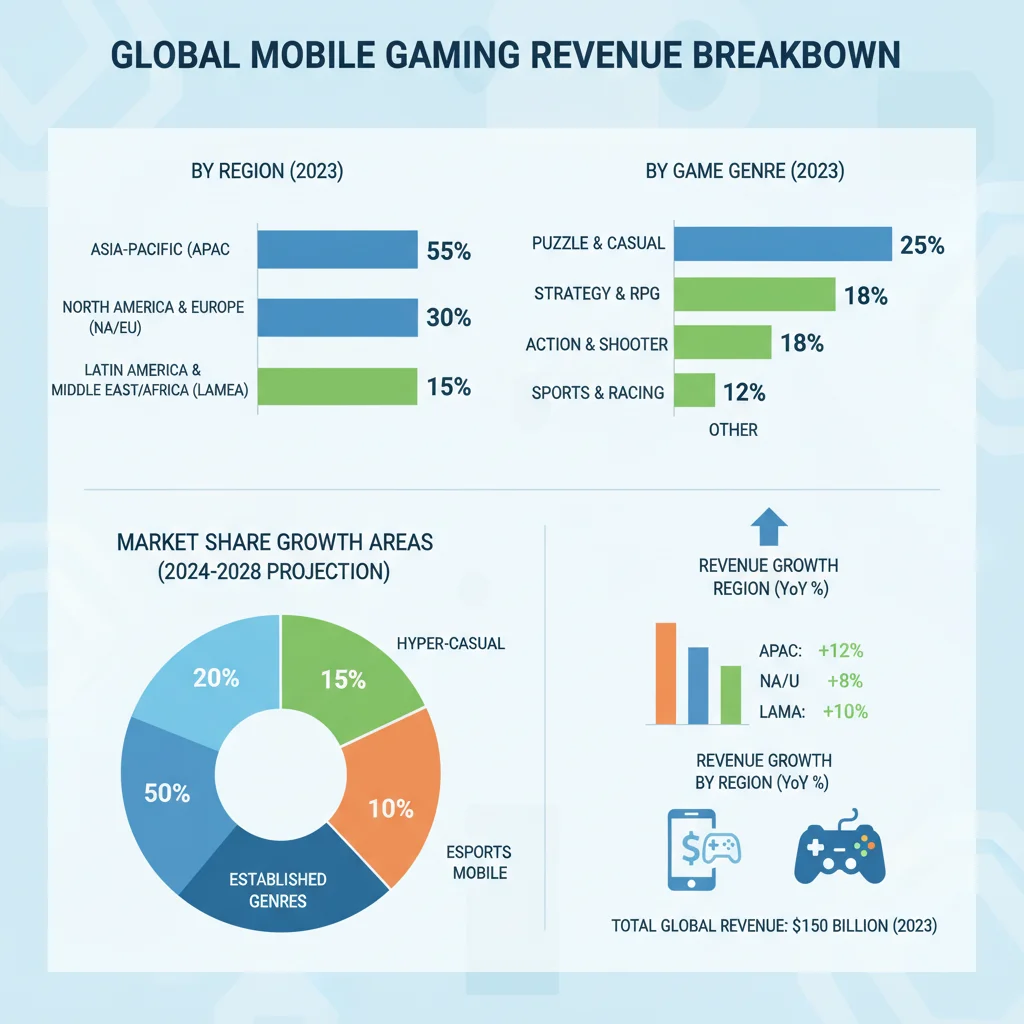
The Six Pillars: Key Titles Driving the $150 Billion Market
While the mobile gaming market is vast and diverse, certain titles stand out as monumental revenue generators, acting as the vanguard of the industry’s growth towards the $150 billion mark by 2026. These games have mastered the art of engagement, monetization, and community building, setting benchmarks for others to follow. While specific rankings can fluctuate, the following six categories or examples represent games with consistently high performance and significant impact on the mobile gaming revenue landscape.
1. Garena Free Fire / PUBG Mobile (Battle Royale Dominance)
The mobile battle royale genre continues its reign as a top revenue driver. Titles like Garena Free Fire and PUBG Mobile have amassed billions in revenue by offering intense, competitive gameplay optimized for mobile devices. Their success lies in their accessibility, frequent content updates (new maps, weapons, characters), and robust esports ecosystems. The constant influx of cosmetic items, battle passes, and exclusive events keeps players engaged and spending, eager to customize their in-game experience and stand out on the battlefield. These games are particularly popular in emerging markets, contributing significantly to global revenue.
2. Genshin Impact (Open-World RPG Phenomenon)
Genshin Impact redefined what was possible for an open-world RPG on mobile. With stunning graphics, a vast world to explore, and a deep gacha monetization system for characters and weapons, it quickly became a global sensation. Its success is attributed to its console-quality production values, continuous story updates, and a compelling character roster that encourages players to spend to acquire their favorites. The game’s cross-platform playability also broadens its appeal, allowing players to seamlessly transition between mobile, PC, and console, further cementing its revenue-generating power.
3. Candy Crush Saga (Casual Gaming Evergreens)
The enduring popularity and consistent revenue of games like Candy Crush Saga demonstrate the power of well-designed casual puzzle games. These titles, while seemingly simple, are incredibly addictive and have massive, broad appeal across all demographics. Their monetization strategies often involve selling extra lives, boosters, or cosmetic items that enhance gameplay or provide a competitive edge. The consistent release of new levels and events keeps the core player base engaged, ensuring a steady stream of revenue years after their initial launch. Their accessibility and ‘pick-up-and-play’ nature make them perfect for mobile.
4. Honor of Kings / Mobile Legends: Bang Bang (MOBA Powerhouses)
Multiplayer Online Battle Arena (MOBA) games like Honor of Kings (also known as Arena of Valor in some regions) and Mobile Legends: Bang Bang are titans in the mobile esports scene and massive revenue generators, particularly in Asia. These games offer strategic, team-based combat that fosters intense competition and community. Their monetization primarily revolves around selling new heroes, character skins, and seasonal passes. The vibrant esports scene surrounding these titles further fuels their popularity and revenue, as players strive to emulate their favorite professional players with in-game purchases.
5. Roblox (User-Generated Content & Metaverse Pioneer)
While not exclusively a ‘game’ in the traditional sense, Roblox is undeniably a mobile gaming powerhouse. Its platform allows users to create and play millions of user-generated games and experiences. The monetization model is driven by ‘Robux,’ an in-game currency used to purchase items, access experiences, and support creators. Roblox‘s success on mobile is due to its strong social features, endless content variety, and its appeal to a younger demographic. It represents a significant shift towards metaverse-like experiences that generate revenue through virtual economies and user engagement.
6. Pokémon GO (Augmented Reality & Location-Based Gaming)
Pokémon GO revolutionized mobile gaming by successfully integrating augmented reality and location-based gameplay. Its unique blend of real-world exploration and digital creature collection captivated millions worldwide. Revenue streams include in-app purchases for Poké Balls, incubators, raid passes, and other items that enhance gameplay. The game’s continued success is attributed to regular content updates, new Pokémon releases, community events, and its ability to encourage physical activity and social interaction. It demonstrates the potential for innovative technologies to create engaging and highly profitable mobile experiences.
These six examples, representing different genres and monetization models, collectively illustrate the diverse strategies driving the mobile gaming revenue towards $150 billion. Their ability to innovate, engage, and retain players through compelling content and smart monetization will continue to shape the industry’s future.
Future Trends Shaping Mobile Gaming Revenue
The journey to $150 billion in mobile gaming revenue by 2026 is not just about current successes; it’s heavily influenced by emerging trends and future innovations. The industry is constantly evolving, with new technologies and shifting player expectations dictating the next wave of growth. Staying ahead of these trends is paramount for developers, publishers, and investors looking to capitalize on this lucrative market.
One of the most significant trends is the continued advancement of Augmented Reality (AR) and Virtual Reality (VR) gaming. While VR is still primarily a niche market for mobile, AR is already making substantial inroads, exemplified by games like Pokémon GO. As AR technology in smartphones improves, allowing for more seamless and immersive overlays of digital content onto the real world, we can expect a new generation of AR-centric games that offer unique gameplay experiences. These games could unlock entirely new monetization opportunities through location-based interactions, real-world events, and highly personalized digital content.
The concept of the Metaverse is another powerful force. While still in its early stages, the vision of persistent, interconnected virtual worlds where users can socialize, play, work, and conduct commerce is highly appealing. Mobile devices are likely to be the primary gateway for many users into these metaverses due to their accessibility. Games like Roblox and Fortnite (on mobile) are already demonstrating elements of this. The metaverse could unlock vast new revenue streams through virtual land sales, unique digital assets (NFTs), virtual events, and an entirely new economy built on user-generated content and brand collaborations.
Cloud gaming is also poised to play a more significant role. Services like Xbox Cloud Gaming and GeForce NOW are making console-quality titles playable on mobile devices without the need for powerful local hardware. This expands the potential audience for graphically intensive games and blurs the lines between traditional gaming platforms and mobile. As internet infrastructure improves globally, cloud gaming will reduce barriers to entry for high-fidelity experiences, potentially attracting new segments of players and increasing overall spending on games previously inaccessible on mobile.
The integration of Web3 technologies, including NFTs and blockchain, is a contentious but potentially transformative trend. While the current implementation faces challenges, the underlying idea of true digital ownership, verifiable scarcity, and player-driven economies could revolutionize monetization. If implemented thoughtfully, without exploiting players, NFTs could create new markets for in-game assets, allowing players to own, trade, and even earn from their digital possessions, thereby adding a new dimension to mobile gaming revenue.
Furthermore, hyper-casual gaming continues to evolve. These games are designed for instant gratification, simple mechanics, and short play sessions. While individual hyper-casual games might not generate massive per-user revenue, their ability to attract billions of downloads and monetize through advertising at scale makes them significant contributors to the overall mobile gaming revenue. Expect more sophisticated ad monetization strategies and hybrid casual games that combine simple mechanics with deeper progression systems to retain players longer.
Finally, AI-driven personalization and adaptive gameplay will become more prevalent. AI can analyze player behavior to offer tailored content, optimize difficulty, and suggest personalized offers, leading to higher engagement and more effective monetization. This bespoke approach can make games feel more responsive and enjoyable, encouraging sustained play and spending. AI can also assist in content generation, allowing for more dynamic and ever-changing game worlds, keeping players consistently surprised and entertained.

Challenges and Opportunities on the Path to $150 Billion
While the mobile gaming market’s trajectory towards $150 billion in revenue by 2026 appears robust, it is not without its challenges. Navigating these obstacles while capitalizing on emerging opportunities will be crucial for sustained growth and profitability. The dynamic nature of the industry demands constant adaptation and strategic foresight from all stakeholders.
One primary challenge is market saturation and discoverability. With millions of apps available, standing out in crowded app stores is increasingly difficult. Developers face intense competition for player attention, requiring substantial marketing budgets and innovative strategies to acquire and retain users. This challenge is further compounded by rising user acquisition costs, making it harder for smaller studios to compete with industry giants.
Regulatory scrutiny and privacy concerns represent another significant hurdle. Governments worldwide are implementing stricter data privacy laws (like GDPR and CCPA), impacting how games collect and utilize player data for advertising and personalization. Changes in platform policies, such as Apple’s App Tracking Transparency (ATT) framework, have already had a profound effect on targeted advertising, forcing developers to rethink their monetization and user acquisition strategies. Compliance with these evolving regulations requires significant investment and continuous adaptation.
Player fatigue and monetization ethics are also growing concerns. Aggressive monetization tactics, ‘pay-to-win’ mechanics, and loot boxes have drawn criticism from players and regulators alike. There’s a delicate balance between generating revenue and maintaining player trust and satisfaction. Developers must innovate in monetization while prioritizing ethical design to foster long-term engagement rather than short-term gains that alienate the player base. The industry needs to demonstrate that it can monetize responsibly.
On the flip side, these challenges present numerous opportunities. The demand for high-quality, innovative content remains insatiable. Developers who can craft compelling narratives, unique gameplay mechanics, and visually stunning experiences will continue to capture significant market share. The success of Genshin Impact, with its console-level production values, is a prime example of this opportunity.
The expansion into emerging markets offers immense growth potential. Regions in Southeast Asia, Latin America, and Africa have rapidly growing smartphone penetration and a burgeoning middle class, representing billions of potential new players. Tailoring games to local cultural preferences, language, and payment methods can unlock significant revenue streams from these untapped markets, contributing substantially to the $150 billion projection.
Cross-platform play and progression are also becoming critical opportunities. As players increasingly use multiple devices, the ability to seamlessly switch between mobile, PC, and console without losing progress enhances convenience and engagement. This approach not only retains players across different platforms but also allows developers to leverage existing IP more effectively, expanding the reach and lifespan of their titles. It creates a more cohesive gaming ecosystem for players.
Furthermore, the opportunity for deeper community engagement and user-generated content (UGC) cannot be overstated. Games that empower players to create, share, and monetize their own content (like Roblox) foster incredibly loyal and active communities. This not only provides an endless stream of fresh content but also shifts some of the development burden to the community, creating a self-sustaining ecosystem that drives both engagement and revenue through virtual economies. Investing in tools and platforms that facilitate UGC will be a key differentiator.
Finally, the continuous evolution of AI and machine learning offers opportunities beyond personalization. AI can be used for more efficient game development, automated testing, real-time fraud detection, and even creating more dynamic and challenging in-game opponents. Embracing these technologies can lead to more efficient operations, higher quality games, and ultimately, greater profitability.
Conclusion: The $150 Billion Horizon and Beyond
The journey of mobile gaming from a niche pastime to a projected $150 billion industry by 2026 is a remarkable narrative of innovation, adaptation, and unprecedented growth. This monumental figure is not merely a statistical projection; it represents a vibrant, dynamic ecosystem fueled by billions of passionate players, ingenious developers, and strategic industry leaders. The forces driving this expansion are multifaceted, ranging from the ubiquity of smartphones and the effectiveness of free-to-play models to technological advancements in AR, VR, and cloud gaming.
The six key titles we’ve highlighted – from the intense battle royales of Garena Free Fire and PUBG Mobile, the expansive open-world of Genshin Impact, the enduring appeal of Candy Crush Saga, the competitive arenas of Honor of Kings and Mobile Legends: Bang Bang, to the user-generated metaverse of Roblox, and the augmented reality adventure of Pokémon GO – serve as powerful examples of the diverse and effective strategies employed to captivate and monetize global audiences. These games, across various genres, have mastered community building, content delivery, and ethical (or at least highly effective) monetization, setting the gold standard for the industry.
Looking ahead, the future of mobile gaming revenue is poised for even greater transformation. The burgeoning metaverse, the increasing sophistication of AI, the evolving landscape of Web3 technologies, and the continued expansion into emerging markets all present formidable opportunities for further growth. However, the path to $150 billion and beyond is not without its challenges. Market saturation, evolving regulatory environments, and the critical need for ethical monetization practices demand constant vigilance and strategic adaptation from all industry participants.
Ultimately, the mobile gaming market’s ascent to $150 billion signifies more than just financial success; it underscores its profound cultural impact and its established role as a primary form of entertainment globally. As technology continues to advance and creative boundaries are pushed, mobile gaming will undoubtedly continue to redefine entertainment, offering ever more immersive, engaging, and innovative experiences. For businesses and enthusiasts alike, the mobile gaming horizon is not just lucrative but also incredibly exciting, promising a future filled with endless possibilities and continued record-breaking revenue.