Gaming Audio Evolution: Dolby Atmos DTS:X Soundbars 2026

The world of gaming is in a constant state of flux, driven by relentless innovation that pushes the boundaries of visual fidelity, interactive storytelling, and, crucially, audio immersion. For years, gamers have sought the ultimate auditory experience, one that transports them directly into the heart of the virtual world. While high-quality headphones have long been the go-to for competitive and immersive play, the emergence of advanced soundbar technologies, particularly those integrating Dolby Atmos and DTS:X, is poised to revolutionise how we perceive and interact with game audio. As we look towards 2026, the convergence of these powerful audio formats with sophisticated soundbar designs promises a future where Gaming Audio Evolution reaches unprecedented heights, offering spatial soundscapes that were once the exclusive domain of dedicated home cinema systems.
The journey to this audio zenith hasn’t been without its challenges. Early soundbars, while offering a significant upgrade from built-in TV speakers, often struggled to deliver true surround sound, relying on psychoacoustic tricks rather than genuine object-based audio. However, the rapid advancements in digital signal processing (DSP), transducer technology, and the widespread adoption of next-generation audio codecs like Dolby Atmos and DTS:X have fundamentally changed the game. These technologies don’t just push sound from different directions; they treat individual sounds as ‘objects’ that can be precisely placed and moved in a three-dimensional space, including overhead. This capability is paramount for gaming, where positional audio can mean the difference between victory and defeat, or simply deepen the emotional connection to the narrative.
In this comprehensive exploration, we will delve into the intricate details of how Dolby Atmos and DTS:X function within the context of soundbars, specifically targeting the gaming market in 2026. We’ll examine the technological underpinnings, the benefits for gamers, the design innovations expected from leading manufacturers, and what the future holds for truly immersive gaming audio. Prepare to have your perceptions of game sound redefined as we uncover the thrilling prospects of Gaming Audio Evolution.
The Foundation of Immersive Sound: Understanding Dolby Atmos and DTS:X
Before we project into 2026, it’s crucial to grasp the core principles behind Dolby Atmos and DTS:X, the twin pillars of next-generation spatial audio. Both technologies aim to move beyond traditional channel-based audio (like 5.1 or 7.1 surround sound) by introducing an object-based approach. This means that instead of mixing audio into fixed channels, sound designers can specify the precise location and movement of individual sounds within a 3D soundfield. This metadata is then interpreted by a compatible audio system, which renders the sounds dynamically based on the available speakers, creating a far more realistic and enveloping experience.
Dolby Atmos: Pinpointing Sound in Three Dimensions
Dolby Atmos, first introduced in cinemas in 2012, made its way into home entertainment and subsequently gaming, offering a revolutionary approach to sound. Its key differentiator is the addition of height channels, allowing sounds to be placed above the listener. Imagine a helicopter flying overhead in a game – with Dolby Atmos, you don’t just hear it moving from left to right, but also distinctly above you, creating a palpable sense of verticality. This is achieved through a combination of a traditional channel-based bed and dynamic audio objects. The metadata accompanying these objects tells the audio renderer where each sound should be in relation to the listener, regardless of the specific speaker configuration. This adaptability is critical for soundbars, which often rely on up-firing speakers and advanced psychoacoustic processing to simulate overhead effects.
DTS:X: Flexible Audio for Every Setup
DTS:X, while sharing the object-based philosophy with Dolby Atmos, offers its own unique advantages. One of its most touted features is its flexibility regarding speaker layouts. Unlike Dolby Atmos, which has specific recommendations for speaker placement, DTS:X is more adaptable, allowing for a wider range of speaker configurations to achieve a similar immersive effect. This ‘agnostic’ approach can be particularly beneficial for soundbars, as it gives manufacturers more leeway in designing their products while still delivering a compelling spatial audio experience. DTS:X also allows for the customisation of sound object placement and volume during playback, offering a degree of personalisation that can be appealing to gamers who want to fine-tune their audio environment. Both technologies, however, are united in their goal: to break free from the limitations of channel-based audio and create a truly three-dimensional sound experience.
Why Soundbars are Becoming the Gaming Audio Powerhouses of Tomorrow
For a long time, the gaming audio landscape was dominated by two primary options: dedicated multi-speaker surround sound systems or high-fidelity gaming headsets. While both offer distinct advantages, soundbars are rapidly carving out a significant niche, especially for console gamers and those seeking a less cluttered setup without sacrificing immersion. The appeal of soundbars lies in their convenience, minimalist design, and increasingly, their ability to deliver sophisticated audio experiences that rival more complex systems. As Gaming Audio Evolution progresses, soundbars are perfectly positioned to lead the charge.
The Convenience Factor: Simplicity Meets Performance
One of the most compelling arguments for soundbars is their inherent simplicity. A traditional 5.1 or 7.1 system requires multiple speakers, extensive wiring, and often, a dedicated AV receiver. This can be daunting for many users, particularly those with limited space or a desire for a clean aesthetic. Soundbars, on the other hand, consolidate multiple speakers and amplification into a single, sleek unit that sits neatly below a television. Modern soundbars often connect via a single HDMI eARC cable, simplifying setup dramatically. This ‘plug-and-play’ convenience, coupled with their improving audio performance, makes them an attractive proposition for gamers who want powerful sound without the hassle.
Overcoming Spatial Limitations with Advanced Psychoacoustics
The biggest challenge for soundbars attempting to deliver true surround and height effects is their physical limitation: all speakers are housed within a single enclosure. However, manufacturers have made incredible strides in overcoming this. Through advanced digital signal processing (DSP), beamforming technology, and carefully angled up-firing and side-firing drivers, soundbars can bounce sound off walls and ceilings to create the illusion of discrete speakers positioned all around and above the listener. While not always a perfect replication of a dedicated system, the effectiveness of these psychoacoustic techniques has improved dramatically, delivering convincing spatial audio that significantly enhances immersion. The integration of Dolby Atmos and DTS:X is what truly unlocks the potential of these techniques, providing the metadata needed for the soundbar’s DSP to precisely render object-based audio in a virtual 3D space.

2026: The Era of Hyper-Immersive Gaming Soundbars
Looking ahead to 2026, the landscape for gaming soundbars is set to be dominated by devices that not only fully embrace Dolby Atmos and DTS:X but also introduce a host of innovations tailored specifically for the gaming community. We can expect a significant leap in both hardware capabilities and software optimisation, further cementing the soundbar’s role as a formidable gaming audio solution. The ongoing Gaming Audio Evolution will be driven by these advancements.
Enhanced Speaker Arrays and Transducer Technology
By 2026, soundbars will likely feature even more sophisticated speaker arrays, incorporating a greater number of drivers, including dedicated tweeters, mid-range drivers, and subwoofers (either integrated or wireless). We anticipate the widespread use of advanced transducer materials and designs that offer wider dispersion patterns and improved clarity, especially for high-frequency effects crucial for positional audio. Up-firing drivers will become standard, and their design will be optimised for more precise reflection off ceilings, creating a more convincing sense of overhead sound. Some premium models might even incorporate adjustable up-firing drivers, allowing users to fine-tune the angle for their specific room acoustics.
AI-Powered Room Calibration and Optimisation
Room acoustics play a significant role in the effectiveness of spatial audio, especially for soundbars that rely on reflections. By 2026, AI-powered room calibration will be a standard feature, moving beyond simple microphone measurements. These systems will use advanced algorithms to not only measure the room’s dimensions and reflective surfaces but also to dynamically adjust the soundbar’s output in real-time, compensating for furniture, wall materials, and even listener position. This will ensure that the Dolby Atmos and DTS:X effects are rendered optimally for each unique gaming environment, providing a consistently immersive experience regardless of the room’s layout. This smart calibration will be a cornerstone of the Gaming Audio Evolution.
Dedicated Gaming Modes and Low Latency Performance
Latency is the enemy of competitive gaming. While traditional soundbars might introduce a slight audio delay, 2026 gaming-focused soundbars will prioritise ultra-low latency connections. This will be achieved through dedicated HDMI 2.1 passthrough ports, ensuring that high-bandwidth audio and video signals are processed with minimal delay. Furthermore, we can expect specific ‘Gaming Modes’ that not only optimise audio processing for positional accuracy and clarity but also potentially disable certain post-processing effects that could introduce latency. These modes might also enhance specific sound cues, such as footsteps or reloading sounds, giving gamers a competitive edge.
Seamless Integration with Gaming Ecosystems
The future of gaming soundbars will also involve deeper integration with gaming consoles and PC ecosystems. Imagine a soundbar that automatically detects the game you’re playing and adjusts its audio profile accordingly, or one that directly communicates with your console to provide contextual audio cues. This level of smart integration will streamline the user experience and ensure that gamers are always getting the best possible audio performance for the title they’re enjoying. Features like automatic switching between gaming and movie modes, based on content detection, will become commonplace.
The Gamer’s Advantage: How Spatial Audio Enhances Gameplay
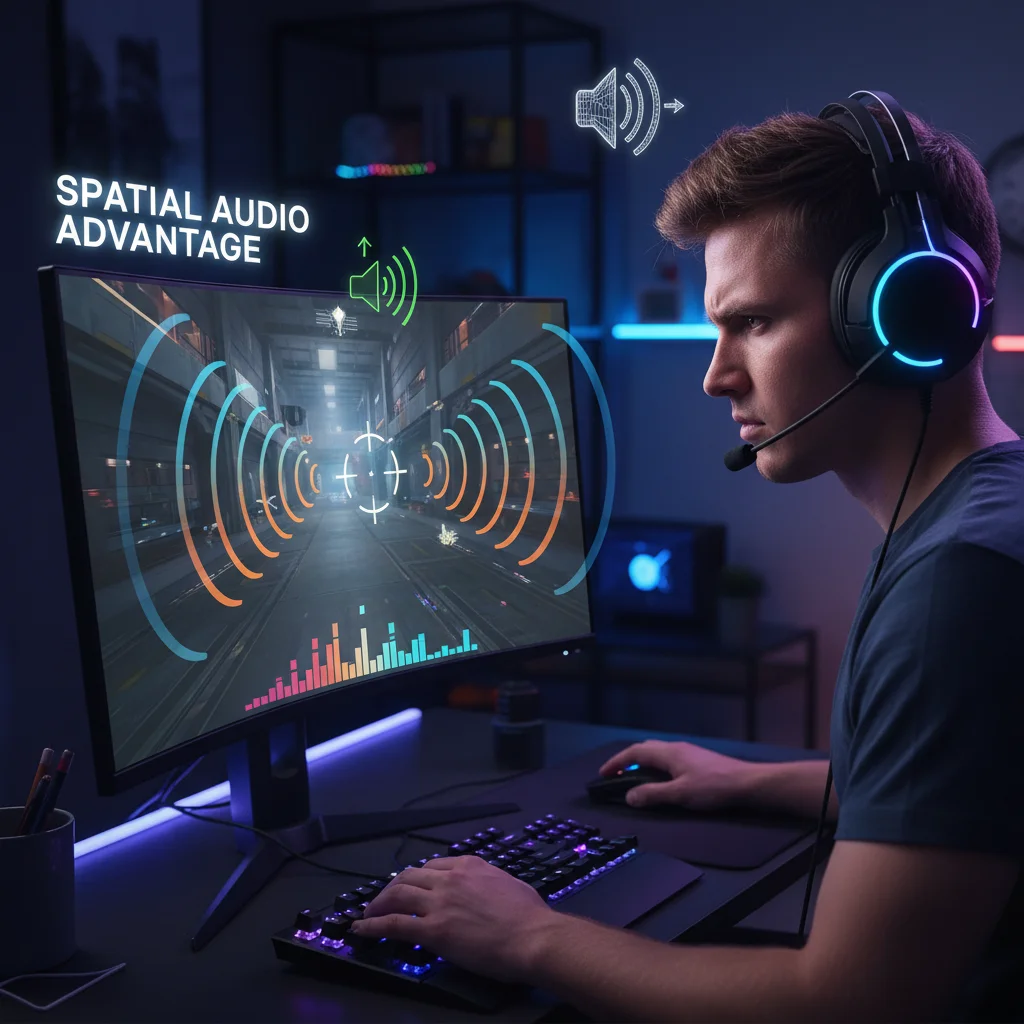
For gamers, the benefits of advanced spatial audio extend far beyond mere immersion. While a truly enveloping soundscape undoubtedly enhances the cinematic quality of a game, the precision offered by Dolby Atmos and DTS:X can provide tangible gameplay advantages, especially in competitive multiplayer titles. This is where the true power of Gaming Audio Evolution shines.
Pinpoint Positional Accuracy: Hearing Every Footstep
In games like first-person shooters or battle royales, knowing the exact location of an enemy before you see them can be the difference between life and death. Traditional stereo or even basic surround sound can give you a general direction, but Dolby Atmos and DTS:X, with their object-based rendering, allow for incredibly precise positional audio. You’ll be able to discern not just if an enemy is to your left or right, but also if they are above you on a balcony, below you in a basement, or even approaching from a specific corner of a room. This level of auditory detail provides an invaluable tactical advantage.
Enhanced Environmental Awareness and Immersion
Beyond competitive advantages, spatial audio dramatically enhances environmental awareness. The subtle sounds of a rustling bush, distant gunfire, or the creak of a floorboard become more distinct and contextualised within the 3D space. This not only makes the game world feel more alive and believable but also allows players to react more intuitively to their surroundings. Imagine the unsettling feeling of hearing a creature scuttling directly behind you and above, or the relief of a friendly voice echoing from a specific direction, guiding you through a complex level. This heightened immersion deepens the emotional connection to the game’s narrative and world-building.
Reducing Cognitive Load: Focusing on the Action
When audio cues are clear and precisely placed, players spend less mental energy trying to interpret vague sounds. This reduction in cognitive load allows gamers to focus more intensely on visual information, tactical decisions, and executing complex manoeuvres. Instead of wondering where a sound is coming from, the spatial audio system tells them instantly, freeing up valuable processing power for other crucial aspects of gameplay. This translates to faster reaction times, better decision-making, and ultimately, a more satisfying and less fatiguing gaming session. The continuous Gaming Audio Evolution is about making the experience smoother and more intuitive.
Challenges and Future Prospects for Gaming Soundbars
While the future of gaming soundbars with Dolby Atmos and DTS:X integration looks incredibly promising, there are still challenges to overcome and exciting avenues for further development. The rapid pace of technological innovation ensures that 2026 is just another stepping stone in the ongoing journey of Gaming Audio Evolution.
Overcoming Room Acoustics and Personalisation
As mentioned, room acoustics remain a significant factor. While AI calibration will improve, truly adapting to every unique room setup will always present a challenge for a single-unit soundbar. Future developments might include more advanced, multi-point calibration systems or even modular soundbar designs that allow for some physical customisation to better suit different room shapes. Personalisation will also extend to individual hearing profiles, allowing soundbars to adapt their output to compensate for variations in a user’s hearing, ensuring everyone experiences the optimal spatial effect.
Integration with Haptic Feedback and VR/AR
The ultimate immersion will likely come from the seamless integration of spatial audio with other sensory feedback mechanisms. Imagine a soundbar that not only produces precise directional audio but also syncs with haptic feedback devices to create vibrations that correspond to in-game events, further blurring the line between the virtual and physical worlds. For VR and AR gaming, spatial audio is absolutely critical, and future soundbars could play a role in creating a more expansive and believable auditory backdrop for these immersive technologies, potentially even wirelessly transmitting personalised audio streams to VR headsets without loss of quality or latency.
The Role of Game Developers and Audio Engineers
The full potential of Dolby Atmos and DTS:X in gaming soundbars can only be realised if game developers and audio engineers fully embrace these technologies during game production. This means investing in tools and workflows that allow for precise object-based audio mixing, ensuring that sound cues are intentionally placed and rendered to take full advantage of spatial audio capabilities. As the install base of Atmos and DTS:X enabled soundbars grows, so too will the incentive for developers to prioritise these advanced audio formats, leading to a virtuous cycle of innovation and adoption.
Key Features to Look for in 2026 Gaming Soundbars
When considering a gaming soundbar in 2026, especially one designed to deliver the pinnacle of Gaming Audio Evolution, several key features will differentiate the best from the rest. Keeping these in mind will help gamers make informed decisions:
- Full Dolby Atmos and DTS:X Support: Ensure the soundbar explicitly states support for both formats, including decoding and rendering capabilities.
- HDMI 2.1 Passthrough with eARC: Essential for uncompressed audio and video signals, ensuring low latency and compatibility with next-gen consoles.
- Dedicated Up-firing Drivers: Look for soundbars with physical up-firing speakers for more convincing overhead effects, rather than relying solely on virtualisation.
- Advanced Room Calibration: AI-powered or sophisticated auto-calibration systems will be crucial for optimising sound for your specific room.
- Gaming Modes: Specific modes that prioritise low latency, enhance positional cues, and adjust audio profiles for different game genres.
- Wireless Subwoofer and/or Rear Speakers: For a more impactful bass response and a true physical surround experience, wireless add-ons are highly beneficial.
- High-Resolution Audio Support: Compatibility with hi-res audio formats ensures the highest fidelity sound reproduction.
- Voice Assistant Integration: For convenience and smart home control, built-in voice assistants can be a useful addition.
- Robust Connectivity Options: Beyond HDMI, consider Bluetooth, Wi-Fi, and optical inputs for versatility.
- Future-Proofing: Software update capabilities are vital to ensure the soundbar can adapt to future audio standards and features.
Conclusion: The Sound of the Future is Here
The trajectory of Gaming Audio Evolution is undeniably heading towards an era of unparalleled immersion, driven by the powerful capabilities of Dolby Atmos and DTS:X integrated into advanced soundbars. By 2026, these devices will transcend their current forms, becoming sophisticated audio hubs that offer not just convenience but also genuinely competitive and deeply immersive soundscapes. The days of sacrificing spatial audio for a clean setup are rapidly fading, replaced by a future where sleek soundbars deliver breathtaking 3D sound that places gamers squarely in the centre of the action.
As technology continues to refine psychoacoustic processing, enhance transducer design, and integrate AI for personalised room optimisation, the gap between dedicated multi-speaker systems and high-end soundbars will continue to narrow. For gamers seeking the ultimate auditory edge, whether for competitive play or pure narrative immersion, the Dolby Atmos and DTS:X enabled soundbar of 2026 will be an indispensable component of their gaming setup. Prepare to hear your games like never before, as the future of gaming audio unfolds in spectacular, three-dimensional glory.
The journey towards this hyper-immersive audio experience is ongoing, and every year brings us closer to a reality where the sounds of virtual worlds are indistinguishable from our own. The Gaming Audio Evolution is not just about louder sounds or more bass; it’s about precision, realism, and a profound connection to the digital universes we explore. Get ready, because 2026 is poised to be a landmark year for gaming audio, and soundbars will be leading the charge.