The Future of Gaming Peripherals in 2026: 3 Innovations That Will Transform Your Gameplay Experience
The world of gaming is in a constant state of evolution, pushing the boundaries of what’s possible and redefining immersion with each passing year. As we inch closer to 2026, the anticipation for groundbreaking advancements in future gaming peripherals reaches a fever pitch. Gone are the days when a simple mouse and keyboard or a basic gamepad sufficed for a truly engaging experience. Today, gamers demand more – more immersion, more responsiveness, and a deeper connection to the virtual worlds they inhabit. This article delves into three pivotal innovations poised to utterly transform your gameplay experience by 2026, setting new benchmarks for interaction and immersion in the gaming landscape.
From the subtle rumble of a controller to the intricate visual fidelity of high-end graphics cards, every component of a gaming setup plays a crucial role in shaping the player’s journey. However, the true game-changers often emerge from the realm of peripherals – those devices that bridge the gap between human intent and digital action. These aren’t just mere accessories; they are extensions of our will, conduits through which we navigate fantastical realms, engage in epic battles, and solve intricate puzzles. The innovations we’re about to explore are not just incremental upgrades; they represent fundamental shifts in how we interact with games, promising a future where the line between the virtual and the real becomes increasingly blurred.
Imagine a scenario where you don’t just see and hear the game, but feel it. Picture a controller that adapts to your unique playstyle, learning your habits and optimising its performance in real-time. Envision a world where your thoughts alone can command your in-game avatar, offering a level of control previously confined to science fiction. These are not distant dreams but tangible possibilities on the horizon, thanks to rapid advancements in haptic feedback technology, artificial intelligence, and neural interfaces. As we explore these exciting developments, prepare to envision a gaming future that promises unprecedented levels of excitement, challenge, and engagement. The era of truly immersive and personalised gaming is not just coming; it’s almost here, spearheaded by these revolutionary future gaming peripherals.
1. Advanced Haptic Feedback Suits and Gloves: Feeling the Game Like Never Before
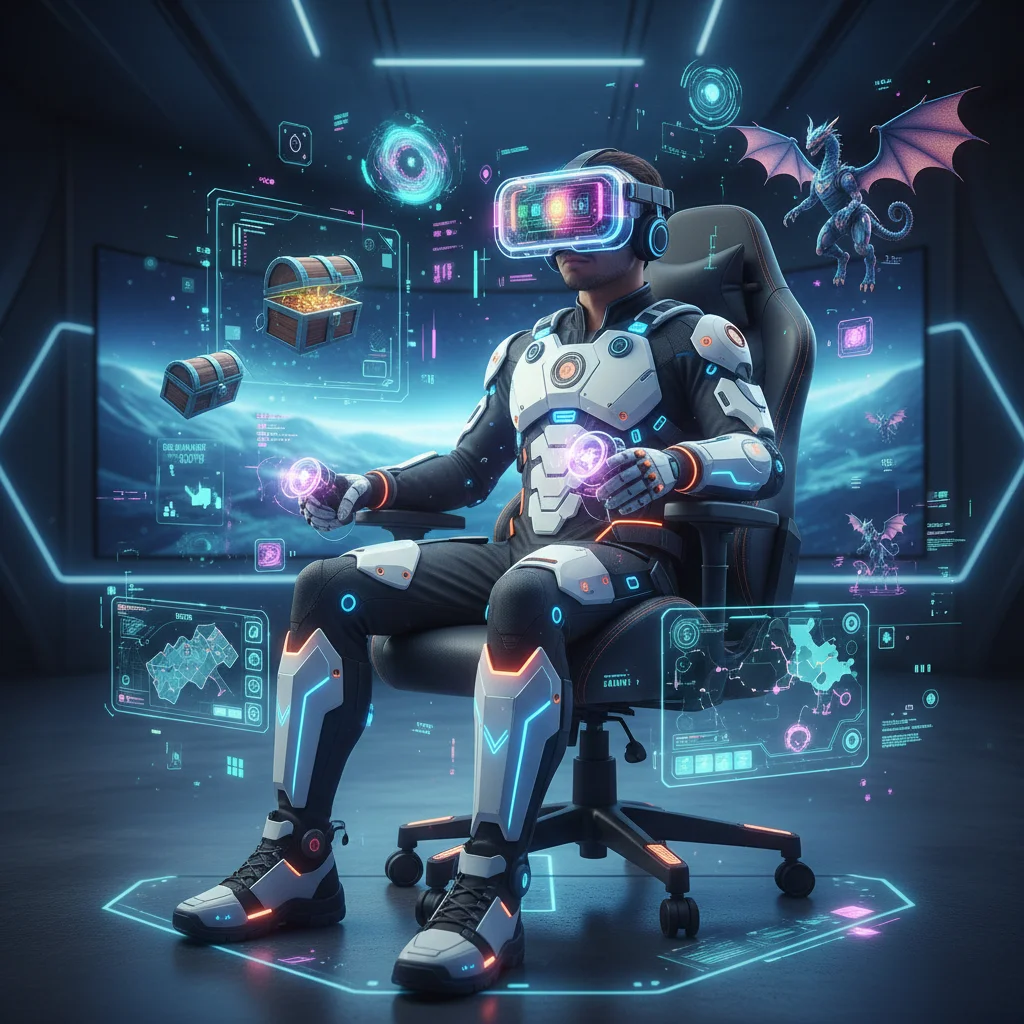
One of the most profound leaps forward in the realm of future gaming peripherals is the evolution of haptic feedback technology. While current controllers offer basic vibrations, the next generation promises full-body immersion through advanced haptic feedback suits and gloves. These sophisticated garments will allow players to experience tactile sensations that directly correspond to in-game events, transforming passive observation into active participation. Imagine feeling the recoil of a powerful weapon, the gentle patter of rain on your virtual skin, or the impact of a close-range explosion – not just as an auditory cue, but as a genuine physical sensation.
The technology behind these suits involves an intricate network of actuators and sensors strategically placed across the body. These actuators can generate a wide range of sensations, from subtle vibrations and pressures to more intense impacts and even temperature changes. For instance, a suit might incorporate micro-actuators that simulate the feeling of a bullet grazing your arm, or pneumatic systems that create the sensation of being pushed back by an explosion. Gloves, meanwhile, will focus on delivering highly localised and nuanced feedback to the hands and fingers, allowing for delicate interactions with virtual objects, such as feeling the texture of a weapon or the resistance of a virtual lock pick.
The Evolution of Haptic Technology
Early iterations of haptic feedback were rudimentary, often limited to simple rumble packs in controllers. However, recent advancements in materials science, miniaturisation, and control algorithms have paved the way for much more sophisticated systems. Researchers are now exploring electroactive polymers and piezoelectric materials that can deform and vibrate with incredible precision, offering a far richer palette of sensations. Furthermore, the integration of thermal elements means that players could feel the heat of a nearby fire or the chill of a frosty environment, adding another layer of realism to the virtual world.
The impact on gameplay will be monumental. In first-person shooters, feeling the distinct kickback of different firearms could enhance weapon mastery and strategic decision-making. In adventure games, the ability to feel environmental cues, such as the texture of ancient ruins or the sensation of climbing a rough cliff face, will deepen immersion and make exploration more engaging. Even in racing games, players could feel the subtle shifts in road surface or the G-forces of a sharp turn, offering a more visceral connection to the vehicle.
Challenges and Opportunities
Of course, developing and integrating these advanced haptic feedback suits presents its own set of challenges. Cost, comfort, and compatibility with a wide range of games are significant hurdles. However, as the technology matures and manufacturing processes become more efficient, prices are expected to drop, making these devices more accessible to the mainstream gaming audience. Developers will also need to learn how to effectively design and implement haptic feedback into their games, ensuring that the sensations are meaningful and enhance the experience rather than becoming a distraction.
Despite these challenges, the potential for advanced haptic feedback to revolutionise gaming is undeniable. By 2026, we can expect to see early adopters enjoying truly multi-sensory gaming experiences, paving the way for a future where gaming is not just seen and heard, but profoundly felt. These future gaming peripherals will redefine what it means to be ‘in’ a game, offering a level of immersion that was once the stuff of science fiction.
2. AI-Powered Adaptive Controllers: Tailored Gameplay at Your Fingertips
The second major innovation set to redefine the gaming landscape by 2026 is the emergence of AI-powered adaptive controllers. While current controllers offer a fixed input method, these intelligent peripherals will learn from your playstyle, adapt to your preferences, and even anticipate your needs, offering a truly personalised and optimised gaming experience. This goes far beyond customisable button mappings; we’re talking about controllers that evolve with you, making your interactions with games more intuitive and efficient.
At the core of these adaptive controllers is sophisticated artificial intelligence. This AI will continuously analyse your inputs, reaction times, movement patterns, and even biometric data (such as heart rate or galvanic skin response, if integrated). By processing this vast amount of information, the controller can identify your strengths, weaknesses, and preferred strategies. For example, if the AI detects that you consistently struggle with a particular quick-time event, it might subtly adjust the timing window or provide a more prominent visual cue. If it notices you frequently use a specific combo in a fighting game, it could optimise the tactile feedback to confirm successful execution.
Personalisation and Performance Enhancement
One of the most exciting aspects of AI-powered adaptive controllers is their ability to enhance performance. For competitive gamers, this could mean the difference between victory and defeat. The AI could recommend optimal sensitivity settings for a first-person shooter based on your aiming precision, or suggest more efficient button layouts for complex RPGs. For casual players, it could mean a more forgiving and enjoyable experience, reducing frustration and allowing them to focus on the narrative or exploration. The controller becomes a personal coach, subtly guiding and assisting without being intrusive.
Beyond performance, these controllers will also focus heavily on ergonomic adaptation. Imagine a controller whose shape subtly shifts to perfectly fit your hands based on your grip style, or whose trigger resistance adjusts dynamically to match the in-game action – a light touch for a pistol, a heavy pull for a sniper rifle. This dynamic physical customisation, driven by AI, will significantly reduce fatigue and improve comfort during extended gaming sessions, making gaming more accessible and enjoyable for a wider audience.
The integration of machine learning algorithms will also allow these controllers to anticipate player actions. For instance, in a fast-paced action game, the controller might predict your next move based on the current context and subtly pre-load a function, reducing input lag and making your reactions feel instantaneous. This predictive capability could even extend to suggesting optimal strategies or highlighting tactical opportunities in real-time, displayed through subtle haptic cues or integrated mini-displays on the controller itself.
The Road Ahead for Adaptive Controllers
The development of AI-powered adaptive controllers requires significant advancements in embedded AI processing, sensor technology, and mechanical engineering. Data privacy and ethical considerations regarding AI learning from player data will also be crucial discussion points as these technologies mature. However, the benefits of a truly personalised and performance-enhancing gaming peripheral are immense.
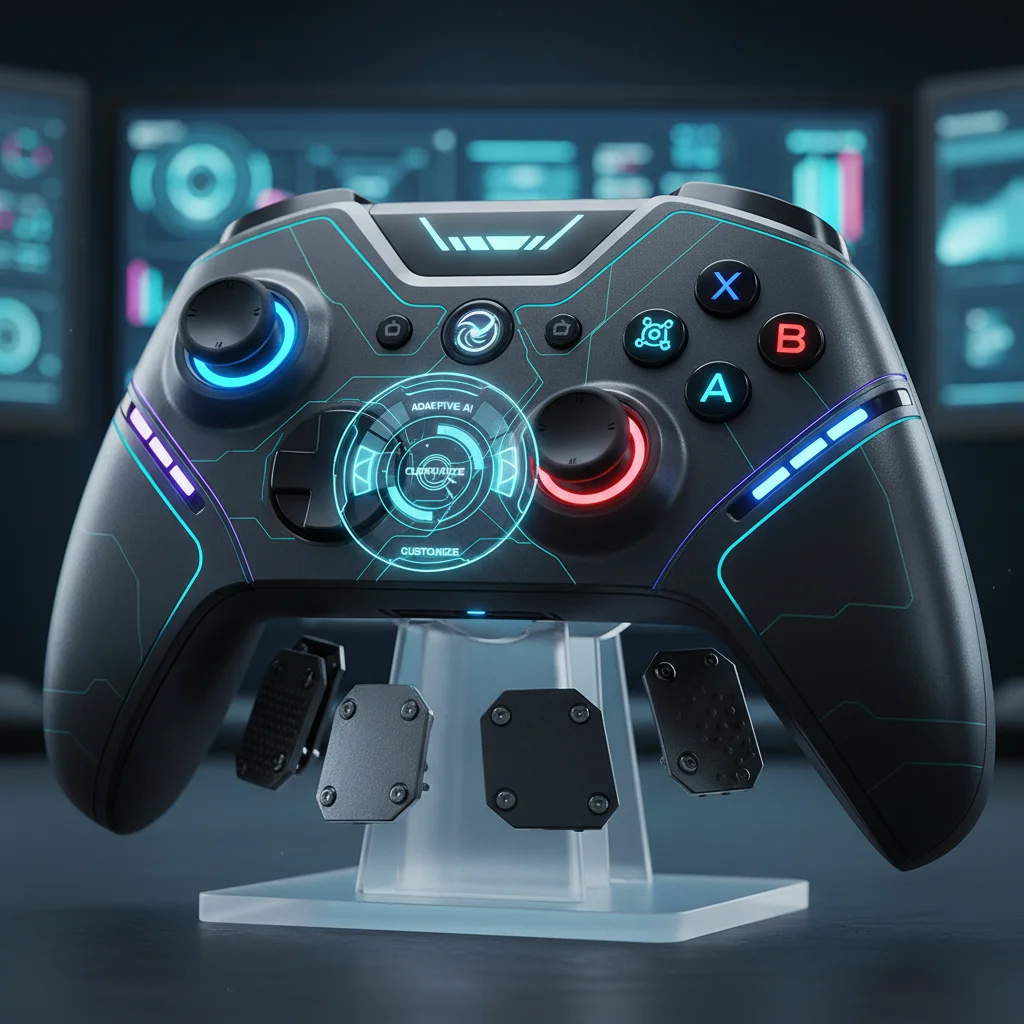
By 2026, we can anticipate the first wave of these intelligent controllers hitting the market, offering a glimpse into a future where your gaming hardware is not just a tool, but an intelligent partner. These future gaming peripherals will redefine the concept of user interface, making every interaction feel natural, intuitive, and perfectly tailored to the individual player, truly transforming how we engage with digital worlds.
3. Neural Interfaces and Brain-Computer Gaming: Direct Thought Control
Perhaps the most revolutionary and potentially transformative innovation among future gaming peripherals by 2026 is the advent of practical neural interfaces, also known as Brain-Computer Interfaces (BCIs) for gaming. While still in its nascent stages for widespread consumer adoption, rapid advancements in neuroscience and miniaturised electronics suggest that rudimentary, yet effective, brain-to-game control could become a reality within the next few years. This technology promises to bypass traditional input devices entirely, allowing players to control games directly with their thoughts.
The basic principle behind neural interfaces involves detecting and interpreting brainwave activity. Non-invasive BCIs, which are the most likely candidates for consumer gaming, typically use electroencephalography (EEG) sensors placed on the scalp. These sensors measure electrical signals generated by the brain, which can then be decoded and translated into commands for a game. While early BCIs were limited to simple commands like ‘move left’ or ‘jump’, ongoing research is dramatically improving the fidelity and complexity of detectable brain signals.
Beyond the Controller: An Unprecedented Connection
Imagine navigating a complex virtual environment, casting spells, or executing intricate manoeuvres simply by thinking about them. This level of direct brain-to-game communication offers an unparalleled sense of connection and immersion. The delay between thought and action would be virtually eliminated, leading to incredibly responsive and intuitive gameplay. For players with physical disabilities, neural interfaces could open up entirely new avenues for gaming, providing a level playing field and enabling participation in games previously inaccessible to them.
The initial applications of neural interfaces in gaming are likely to focus on augmenting existing control schemes rather than entirely replacing them. For example, a player might use a traditional controller for movement and primary actions, while a neural interface handles secondary commands like selecting inventory items, activating special abilities, or even controlling camera angles with subtle mental cues. This hybrid approach could offer the best of both worlds, combining the precision of physical input with the intuitive speed of thought control.
As the technology matures, we can expect to see more sophisticated applications. Imagine a horror game where your fear response, detected by the BCI, directly influences the in-game atmosphere, making it more intense. Or a puzzle game where the speed of your mental problem-solving affects the difficulty. The possibilities are truly boundless, extending beyond mere control to impact the very fabric of the gaming experience itself.
Ethical Considerations and Future Potential
The development of neural interfaces for gaming does raise important ethical questions, particularly concerning data privacy, mental fatigue, and the potential for unintended mental impact. Ensuring the security of brainwave data and designing interfaces that are safe and comfortable for prolonged use will be paramount. However, the potential benefits for accessibility, immersion, and fundamentally changing how we interact with digital worlds are so significant that research and development are accelerating rapidly.

By 2026, while full mind-control gaming might still be a few years away from mainstream adoption, we anticipate the introduction of consumer-grade neural interfaces that provide meaningful, thought-driven interactions within games. These future gaming peripherals will represent the cutting edge of human-computer interaction, offering a glimpse into a future where our minds are directly connected to the digital realms, unlocking new dimensions of gameplay and immersion.
The Convergence of Innovations: A Synergistic Future
While we’ve discussed advanced haptic feedback, AI-powered adaptive controllers, and neural interfaces as distinct innovations, the true magic will happen when these technologies begin to converge. Imagine a gaming experience where your haptic suit provides precise tactile feedback, your AI-powered controller dynamically adjusts to your actions, and your neural interface allows for instantaneous, thought-driven commands. This synergistic integration of future gaming peripherals promises an unprecedented level of immersion and responsiveness, blurring the lines between player and game.
For instance, a neural interface could detect a player’s intention to perform a specific action, and the AI controller could immediately adjust its sensitivity or haptic feedback to complement that action, while the haptic suit delivers the corresponding physical sensation. This creates a seamless loop of input, feedback, and adaptation that is incredibly powerful. The controller isn’t just a device; it’s a smart extension of your body, communicating with your brain and the game world in real-time, enhancing your senses.
Impact on Game Design and Development
The emergence of these advanced peripherals will also profoundly impact game design. Developers will no longer be limited to visual and auditory cues but can leverage tactile and even thought-based interactions to create richer narratives, more complex gameplay mechanics, and deeper emotional connections with players. Puzzles could involve subtle haptic clues, character interactions could be influenced by detected emotional states via neural interfaces, and combat systems could become far more nuanced and reactive to player intent.
This convergence will also push the boundaries of virtual reality (VR) and augmented reality (AR). When combined with high-fidelity VR headsets, haptic suits and neural interfaces will elevate the sense of presence to new heights. You won’t just be looking at a virtual world; you’ll be truly in it, feeling its textures, controlling its elements with your mind, and experiencing its events with your entire body. AR gaming, too, could benefit immensely, allowing for more intuitive interactions with digital elements overlaid onto the real world.
Accessibility and Inclusivity
Beyond the enhanced immersion for all players, the convergence of these technologies holds immense promise for accessibility. Neural interfaces, in particular, could empower individuals with severe motor impairments to participate fully in gaming, providing a vital source of entertainment and social connection. AI-powered adaptive controllers can further customise experiences for players with diverse needs, ensuring that gaming is a truly inclusive hobby. The goal is to remove barriers and make the joy of gaming accessible to everyone, regardless of their physical abilities.
The journey towards fully integrated and universally accessible gaming experiences is complex, requiring ongoing research, ethical consideration, and collaborative efforts between hardware manufacturers, software developers, and the gaming community. However, the trajectory is clear: the future of gaming is one where the interface between human and machine becomes increasingly seamless, intuitive, and deeply personal. These converging future gaming peripherals are not just about playing games; they’re about experiencing them in a way that was once unimaginable.
Conclusion: The Dawn of a New Gaming Era
As we look forward to 2026, the landscape of gaming is set to undergo a dramatic transformation, driven by incredible advancements in peripheral technology. The three innovations we’ve explored – advanced haptic feedback suits and gloves, AI-powered adaptive controllers, and nascent neural interfaces – are not isolated developments but interconnected pieces of a larger puzzle, coming together to form a truly revolutionary gaming experience. These future gaming peripherals promise to elevate immersion, personalise interactions, and fundamentally change how we perceive and engage with digital worlds.
The days of merely observing a game are rapidly fading. The future belongs to active participation, where every sense is engaged, every action is intuitive, and every experience is tailored to the individual. Haptic feedback will allow us to feel the game’s pulse, AI-powered controllers will adapt to our every whim, and neural interfaces will bridge the gap between thought and action, creating a direct conduit to the virtual realm. This isn’t just about playing better; it’s about experiencing games on a profoundly deeper, more personal level.
While challenges remain in terms of cost, accessibility, and ethical considerations, the relentless pace of technological innovation suggests that these hurdles will be overcome. The investments being made in research and development, coupled with the ever-growing demand for more immersive experiences, guarantee that these innovations will not only reach the market but will continue to evolve at an astonishing rate. The gaming industry is on the cusp of a new era, one defined by unprecedented levels of interaction and immersion, all powered by these groundbreaking peripherals.
So, get ready. The future of gaming is not just about faster processors or prettier graphics; it’s about a complete redefinition of the player experience. By 2026, your gameplay will be transformed in ways you can only begin to imagine, thanks to these incredible future gaming peripherals. The next generation of gaming is not just coming; it’s knocking on the door, ready to invite you into worlds you won’t just play, but truly live.
