New GPU Architectures 2026: Ray Tracing Improvements for US Gamers
New GPU Architectures for 2026: What US Gamers Need to Know About Ray Tracing Improvements
The year 2026 promises to be a landmark year for PC gaming, particularly for those passionate about cutting-edge graphics and immersive experiences. As we inch closer to the mid-point of the decade, the advancements in GPU architectures 2026 are poised to redefine visual fidelity, with ray tracing improvements leading the charge. For US gamers, this isn’t just about faster frame rates; it’s about a fundamental shift in how virtual worlds are rendered, offering unprecedented realism and depth.
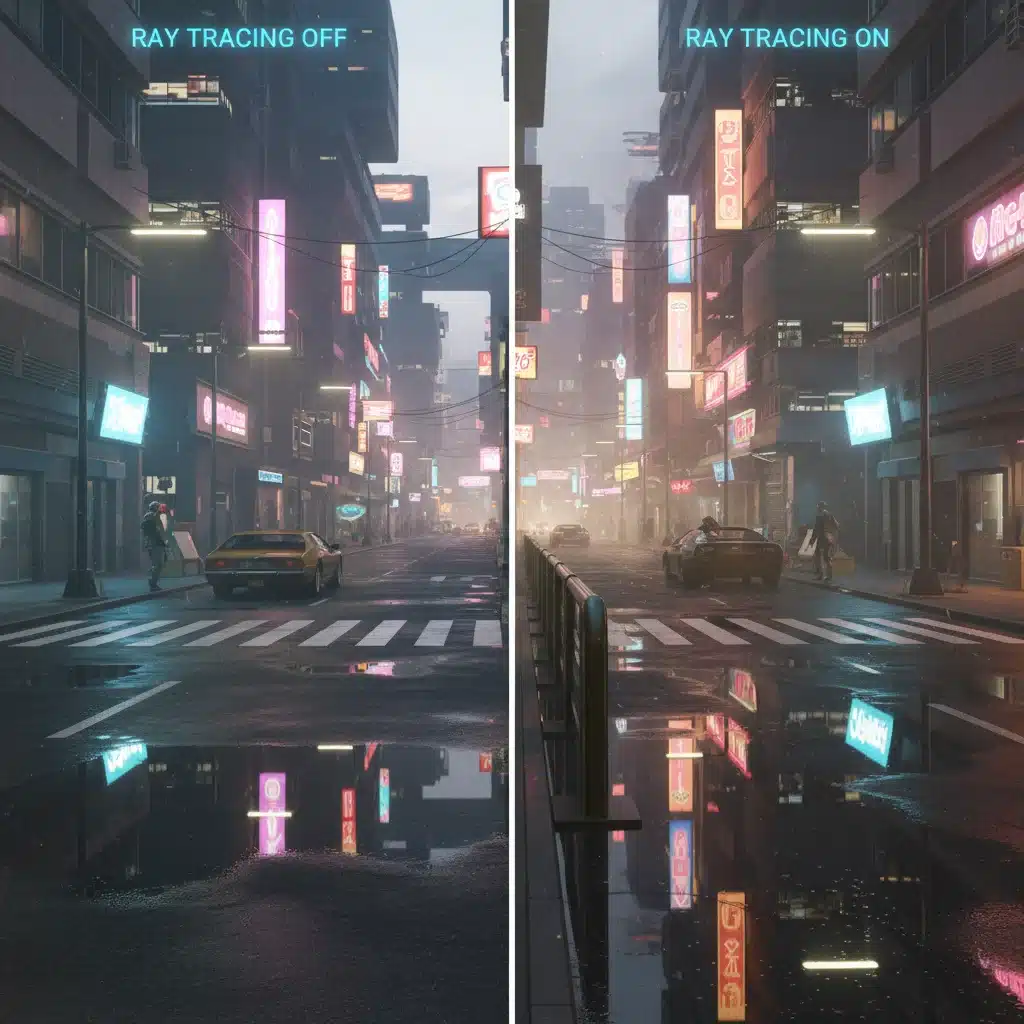
Ray tracing, once a computationally intensive luxury, is rapidly becoming an indispensable component of modern gaming. Its ability to simulate the physical behavior of light, offering hyper-realistic reflections, shadows, and global illumination, has captivated the gaming community. However, current implementations, while impressive, often come with performance caveats. The next generation of GPU architectures 2026 aims to dismantle these barriers, making sophisticated ray tracing not just feasible, but a standard expectation across a wider range of hardware.
The Evolution of Ray Tracing: From Niche to Necessity
To truly appreciate what’s coming with GPU architectures 2026, it’s essential to understand the journey of ray tracing. When NVIDIA first introduced real-time ray tracing with their RTX 20 series GPUs, it was met with both awe and skepticism. The visual improvements were undeniable, but the performance hit was significant, often requiring sacrifices in resolution or frame rate. AMD followed suit, integrating ray tracing capabilities into their RDNA architecture, further democratizing the technology.
Over the past few years, we’ve seen iterative improvements. Dedicated RT Cores and similar hardware accelerators have become more efficient, and software optimizations, including upscaling technologies like DLSS and FSR, have helped mitigate performance concerns. Yet, a truly uncompromised ray tracing experience, especially at higher resolutions and frame rates, remains elusive for many. This is precisely the gap that the GPU architectures 2026 are designed to fill.
Key Innovations Driving Ray Tracing in 2026
Several technological advancements are converging to make 2026 a pivotal year for ray tracing. These innovations span hardware design, software optimization, and even the fundamental algorithms used to simulate light.
Dedicated Ray Tracing Cores: More Than Just Brute Force
While current GPUs feature dedicated ray tracing cores, the GPU architectures 2026 will likely see a significant redesign and enhancement of these units. Expect not just more cores, but smarter, more efficient ones. This could involve:
- Improved BVH (Bounding Volume Hierarchy) Traversal: BVH is a data structure used to accelerate ray intersection tests. Future architectures will likely feature hardware-level enhancements for faster BVH construction and traversal, reducing the time it takes for a ray to find its target.
- Enhanced Ray-Primitive Intersection Engines: The actual intersection of a ray with a triangle or other geometric primitive is a critical step. New architectures may introduce specialized units capable of handling complex intersections more rapidly and with greater precision, reducing latency in light path calculations.
- Asynchronous Ray Tracing: Current implementations often execute ray tracing tasks synchronously. Future GPUs might leverage more advanced asynchronous computing models, allowing ray tracing operations to run in parallel with traditional rasterization tasks without significant bottlenecks, leading to better resource utilization and smoother performance.
Advanced Memory Subsystems and Bandwidth
Ray tracing is incredibly memory-intensive. Storing and accessing the complex geometric data required for light path calculations demands immense bandwidth. The GPU architectures 2026 will undoubtedly feature:
- Next-Generation GDDR Memory: Expect the adoption of even faster GDDR variants, potentially GDDR7 or its successors, offering significantly higher bandwidth compared to current GDDR6X. This increased throughput will be crucial for feeding the hungry ray tracing cores with the necessary data in real-time.
- Larger Cache Hierarchies: GPUs will likely integrate more sophisticated and larger on-chip cache systems. This reduces the need to constantly access slower main memory, speeding up frequently used data and improving overall ray tracing performance.
- Memory Compression Techniques: Further advancements in lossless and near-lossless memory compression algorithms will help reduce the effective memory footprint of ray tracing data, allowing more information to be stored and accessed efficiently.
AI and Machine Learning Integration
Artificial intelligence is already playing a transformative role in gaming graphics, most notably with upscaling technologies. For GPU architectures 2026, AI’s role in ray tracing will deepen:
- AI-Accelerated Denoising: Ray tracing inherently produces noisy images due to the probabilistic nature of light path sampling. AI-powered denoisers are already critical, but 2026 GPUs will feature even more powerful, hardware-accelerated AI units specifically tuned for real-time denoising, leading to cleaner, more stable ray-traced images with fewer artifacts and lower performance cost.
- Neural Radiance Fields (NeRFs) and Neural Rendering: While still experimental for real-time gaming, NeRFs represent a paradigm shift in how 3D scenes can be represented and rendered. Future GPUs might include dedicated hardware for accelerating neural rendering pipelines, potentially offering photorealistic scenes with ray tracing-like qualities at a fraction of the traditional rendering cost.
- Adaptive Ray Tracing: AI could be used to dynamically adjust the number of rays cast per pixel based on scene complexity, motion, and visual importance. This intelligent allocation of resources would ensure optimal performance without compromising perceived visual quality.
Impact on US Gamers: What to Expect
For US gamers, these technological leaps in GPU architectures 2026 translate into a dramatically enhanced gaming experience. The improvements will be felt across various aspects of visual fidelity and immersion.
Hyper-Realistic Lighting and Shadows
The most immediate and noticeable improvement will be in lighting. Global illumination, which simulates how light bounces off surfaces and illuminates a scene indirectly, will become far more commonplace and accurate. This means:
- Dynamic, Natural Lighting: Sunlight will realistically filter through foliage, bounce off coloured walls, and illuminate interiors with a natural softness.
- Accurate Soft Shadows: Shadows will no longer be mere approximations but will accurately reflect the size, shape, and distance of light sources, with soft edges that grow blurrier further from the object.
- Volumetric Lighting Enhancements: Light shafts and fog will interact with ray-traced light sources more convincingly, creating breathtaking atmospheric effects.
Unprecedented Reflections and Refractions
Ray tracing’s strength in reflections is already evident, but 2026 will push this further:
- Pixel-Perfect Reflections: Every reflective surface, from puddles and polished floors to metallic armor and glass, will accurately mirror its surroundings, even off-screen elements, without the visual compromises of screen-space reflections.
- Complex Refractions: Glass, water, and other transparent materials will realistically bend and distort light, adding another layer of realism to environmental interactions.
- Interactive Reflective Surfaces: Dynamic elements like character movement or explosions will be accurately reflected in real-time, enhancing environmental feedback.
Advanced Ambient Occlusion and Caustics
Subtleties in lighting will also see major upgrades:
- Accurate Ambient Occlusion: The subtle darkening in corners and crevices where light struggles to reach will be rendered with physical accuracy, adding depth and realism to objects and environments.
- Real-time Caustics: The complex patterns of light refracted through transparent objects, like light dancing on the bottom of a swimming pool, could become a real-time feature, adding an incredible level of detail previously only seen in offline rendering.
Performance Expectations and Accessibility
One of the biggest questions for US gamers is how these advancements will affect performance and accessibility. The goal of GPU architectures 2026 is not just to improve ray tracing, but to make it performant enough for a wider audience.
Targeting High Frame Rates at High Resolutions
With the new architectures, it’s reasonable to expect that high-end GPUs will be capable of running demanding titles with full ray tracing enabled at 4K resolution and 60+ frames per second, or even higher refresh rates at 1440p. Mid-range GPUs should comfortably handle 1440p with ray tracing, and 1080p will likely see ray tracing become a standard feature with minimal performance impact.
Upscaling Technologies: The Unsung Heroes
Upscaling technologies like NVIDIA’s DLSS, AMD’s FSR, and Intel’s XeSS will continue to evolve and become even more integrated into the rendering pipeline. These technologies, powered by dedicated AI hardware, will be crucial in achieving high frame rates with sophisticated ray tracing. The GPU architectures 2026 will likely feature further refinements to these AI accelerators, enabling even better image quality and performance scaling.
Wider Adoption by Game Developers
As the hardware becomes more capable and widespread, game developers will be more inclined to fully integrate advanced ray tracing into their engines. This means more games will feature comprehensive ray tracing implementations, rather than just limited effects, offering a truly transformative visual experience across the industry.
The Competitive Landscape: NVIDIA, AMD, and Intel
The race to deliver the best GPU architectures 2026 will be fierce among the major players: NVIDIA, AMD, and Intel. Each company brings its unique strengths to the table.
NVIDIA: Doubling Down on RT Cores and AI
NVIDIA, having pioneered real-time ray tracing, will likely continue to push the boundaries with their next-generation architectures. Expect significant generational leaps in RT Core performance, potentially with new architectural designs that handle complex light paths more efficiently. Their DLSS technology will undoubtedly see further iterations, leveraging even more powerful Tensor Cores for superior upscaling and denoising. NVIDIA’s focus will likely remain on delivering the absolute best ray tracing performance and image quality.
AMD: Expanding Ecosystem and Efficiency
AMD has been steadily improving its ray tracing capabilities with each RDNA generation. For 2026, AMD will likely focus on improving the efficiency of their ray accelerators, aiming for a better performance-per-watt ratio. Their FSR technology, being open-source, has a broader adoption base and will continue to be a key component in their strategy, evolving to offer competitive image quality. AMD’s strength lies in its integrated ecosystem (CPU + GPU) and its commitment to open standards, potentially driving broader accessibility for ray tracing.
Intel: The Challenger’s Innovation
Intel, a relatively newer entrant into the discrete GPU market, has shown ambition with its Arc Alchemist series. While their initial ray tracing performance was competitive but not leading, their future GPU architectures 2026 (e.g., Battlemage or Celestial) could bring significant architectural innovations. Intel’s deep expertise in chip design and manufacturing, coupled with their XeSS upscaling technology, positions them as a formidable challenger. They might introduce novel approaches to ray tracing acceleration, leveraging their extensive R&D capabilities.
Challenges and Considerations for 2026
While the future looks bright, there are still challenges that GPU architectures 2026 will need to address:
- Power Consumption: Delivering hyper-realistic graphics with advanced ray tracing will demand significant power. Manufacturers will need to balance performance gains with power efficiency to avoid prohibitive energy costs and thermal issues, especially for smaller form factors and laptops.
- Developer Adoption: While hardware will be more capable, convincing all developers to fully embrace and optimize for advanced ray tracing techniques remains a hurdle. Game engine support and robust development tools will be crucial.
- Cost: Cutting-edge technology often comes with a premium price tag. While performance will improve across all tiers, the most advanced ray tracing experiences might initially be reserved for high-end hardware, potentially limiting immediate widespread adoption among all US gamers.
- Standardization: As more vendors enter the ray tracing space, ensuring a consistent experience and interoperability across different hardware and software platforms will be important. APIs like DirectX Raytracing (DXR) and Vulkan Ray Tracing are helping, but continuous collaboration is needed.
Beyond Gaming: The Broader Impact of Advanced GPU Architectures
The advancements in GPU architectures 2026 and their ray tracing capabilities extend far beyond just gaming. These technologies have profound implications for various industries:
- Professional Visualization: Architects, designers, and engineers can leverage real-time photorealistic rendering for faster iterations and more accurate visualisations of their projects.
- Film and Animation: Real-time ray tracing can revolutionize pre-visualization and final rendering pipelines, significantly reducing production times and costs for CGI.
- Virtual and Augmented Reality (VR/AR): Achieving photorealistic graphics in VR/AR environments is critical for immersion. Enhanced ray tracing will make these virtual worlds indistinguishable from reality, paving the way for more compelling experiences.
- Scientific Simulation: Fields like medical imaging, fluid dynamics, and astrophysics rely on complex simulations. GPUs capable of advanced light interaction can render these simulations with greater fidelity and speed, leading to new discoveries.
- Autonomous Driving and Robotics: Realistic simulation environments are crucial for training AI in autonomous systems. Ray tracing can create highly accurate virtual worlds for testing and development.
Preparing for the Future: What US Gamers Can Do Now
While 2026 is still a couple of years away, US gamers interested in being at the forefront of these advancements can start preparing:
- Stay Informed: Follow tech news, industry announcements, and developer updates to keep abreast of the latest hardware and software developments.
- Consider Your Current Hardware: If you’re planning a GPU upgrade in the near future, consider models with dedicated ray tracing cores and ample VRAM, as these will offer better longevity and compatibility with future titles.
- Monitor Game Engine Developments: Keep an eye on updates from major game engine providers like Epic Games (Unreal Engine) and Unity, as their advancements will directly influence how ray tracing is implemented in upcoming games.
- Budget Wisely: Next-generation hardware often comes with a significant investment. Start planning your budget if you aim to acquire a top-tier GPU in 2026 to fully experience the ray tracing revolution.
Conclusion: A New Era of Visual Immersion
The promise of GPU architectures 2026, particularly their focus on radical ray tracing improvements, heralds a new era for gaming. For US gamers, this means a future where virtual worlds are rendered with unparalleled realism, where every reflection, shadow, and light bounce contributes to a deeply immersive experience. The technological hurdles are being systematically overcome, paving the way for ray tracing to move from a demanding feature to a fundamental expectation.
As NVIDIA, AMD, and Intel push the boundaries of silicon and software, the competition will undoubtedly drive innovation, benefiting consumers with more powerful and efficient graphics cards. The journey towards photorealistic gaming is accelerating, and 2026 is set to be a pivotal year in this exciting evolution. Get ready to experience your favorite games like never before, bathed in the glow of truly realistic light.