In the ever-evolving landscape of portable gaming, Sony has once again captured the attention of enthusiasts with its latest venture: Project Q. Officially revealed as the PlayStation Portal, this device promises to extend the PlayStation 5 experience beyond the living room TV, offering a dedicated handheld for remote play. As the US market continues to embrace a diverse range of handheld gaming options, understanding the specifics of PlayStation Project Q, its capabilities, and how it stacks up against established competitors is crucial for any potential buyer. This comprehensive article will delve into the intricacies of Project Q, unpack its latest specifications, analyse its unique proposition, and provide a detailed comparison with current handhelds, helping you navigate the exciting world of portable gaming.
The announcement of PlayStation Project Q, now known as PlayStation Portal, sparked immediate discussion among gamers. Unlike traditional handheld consoles that run games natively, Project Q is designed exclusively for remote play, leveraging your existing PlayStation 5 console. This fundamental difference sets it apart from devices like the Nintendo Switch or Valve Steam Deck, positioning it as a companion device rather than a standalone gaming system. This distinction is vital for understanding its place in the market and assessing its value proposition for different types of gamers.
Understanding PlayStation Project Q: The Core Concept
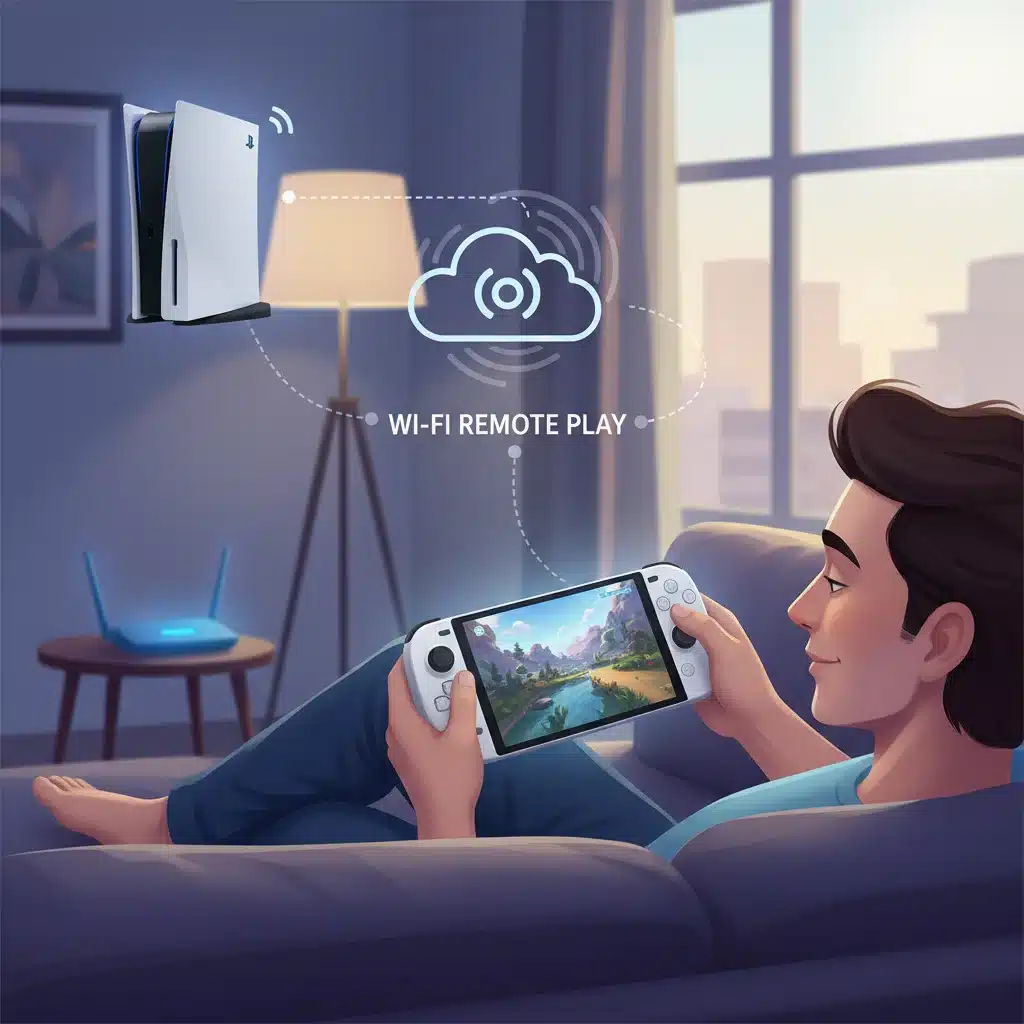
At its heart, PlayStation Project Q is a dedicated Remote Play device. It is not a cloud gaming console, nor does it run games locally. Instead, it streams games directly from your PlayStation 5 console over your home Wi-Fi network. This means that to use Project Q, you must own a PlayStation 5, and both devices must be connected to the same Wi-Fi network, or at least a strong internet connection for remote streaming outside the home network. This paradigm offers a unique advantage: access to your full PS5 game library on a portable screen, without needing to occupy the main TV.
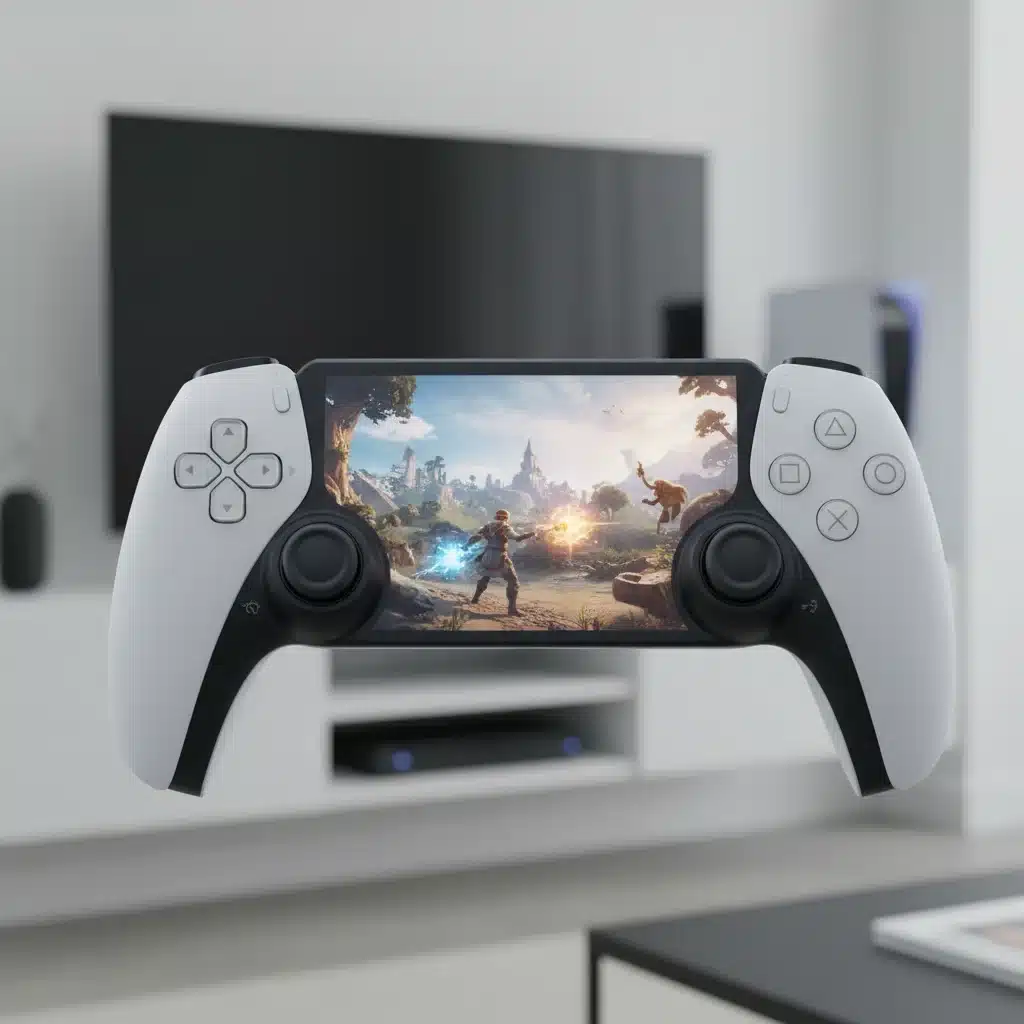
The design of the PlayStation Project Q is immediately striking. It features an 8-inch LCD screen nestled between what are essentially two halves of a DualSense controller. This integration of the iconic DualSense experience into a handheld form factor is a significant draw. Gamers familiar with the PS5’s haptic feedback and adaptive triggers will find a seamless transition to the Project Q, ensuring that the tactile immersion of PS5 gaming is preserved even when playing remotely. This commitment to maintaining the core PlayStation experience is a key selling point for Sony.
The focus on Remote Play means that the performance of Project Q is heavily reliant on the quality and stability of your home network. A robust Wi-Fi 6 connection is recommended to ensure minimal latency and a smooth gaming experience. While this might be a limitation for some, it also means that the device itself doesn’t require high-end internal processing power, potentially keeping its cost more accessible. However, it also means that you won’t be playing your PS5 games on the go without a strong internet connection, limiting its use in scenarios like air travel or areas with poor Wi-Fi.
Unveiling the Latest PlayStation Project Q Specs
While Sony has been somewhat guarded with every single detail, key specifications for the PlayStation Project Q (PlayStation Portal) have been confirmed, giving us a clear picture of its capabilities.
Display: The centrepiece of Project Q is its 8-inch LCD screen. This is a significant size for a handheld, offering ample screen real estate for immersive gaming. The LCD technology suggests a balance between cost and quality, providing vibrant colours and good viewing angles. It supports a resolution of 1080p (1920×1080 pixels) at 60 frames per second (fps). This resolution and refresh rate are perfectly adequate for streaming PS5 games, as the PS5 itself often targets 4K at 60fps, which is then downscaled for the Project Q’s display. While not an OLED screen, which offers deeper blacks and higher contrast, the 8-inch LCD should still deliver a satisfying visual experience for remote play.
Controls: As mentioned, the device integrates the core features of the DualSense wireless controller. This includes haptic feedback, adaptive triggers, and all the standard buttons, sticks, and a touchpad. The inclusion of these features is paramount for maintaining the authentic PS5 gaming experience. The adaptive triggers, in particular, offer varying levels of resistance that can dramatically enhance gameplay in titles that utilise them effectively, such as Spider-Man: Miles Morales or God of War Ragnarök.
Connectivity: Project Q relies exclusively on Wi-Fi for connectivity. It supports Wi-Fi 5 (802.11ac) and likely Wi-Fi 6 for optimal performance. There is no cellular connectivity, meaning you’ll always need a Wi-Fi connection to stream games. This is a crucial point for understanding its portability limitations. For audio, it includes a 3.5mm headphone jack, allowing for wired audio solutions. Interestingly, it does not support Bluetooth audio directly for headphones, instead relying on Sony’s proprietary PlayStation Link wireless technology for compatible audio devices like the new Pulse Elite and Pulse Explore headsets. This decision might be a point of contention for users with existing Bluetooth headphones.
Battery Life: While exact figures can vary based on usage, early reports and Sony’s typical battery performance for similar devices suggest a battery life in the range of 5-8 hours. This is comparable to many other handheld devices and should be sufficient for most remote play sessions, though heavy users might find themselves needing to recharge during extended play.
Other Features: The device includes built-in speakers for audio playback without headphones. It also features a USB-C port for charging. There’s no indication of any internal storage for games, as it’s purely a streaming device. It’s designed to be a straightforward portal to your PS5, without additional complexities.
PlayStation Project Q vs. Current Handhelds in the US Market
To truly appreciate the PlayStation Project Q, it’s essential to compare it with the established players in the US handheld gaming market. This comparison will highlight where Project Q stands out and where its unique approach might be a limiting factor.
Nintendo Switch OLED
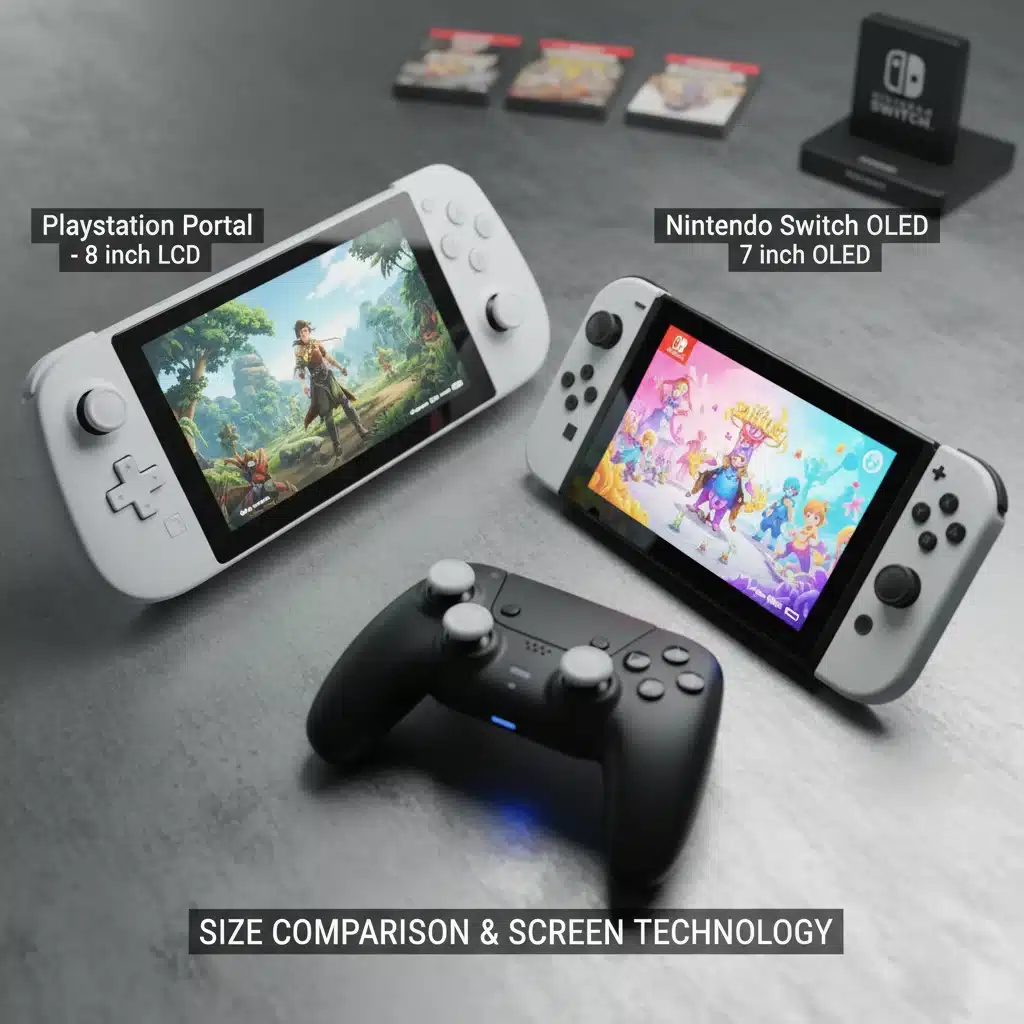
The Nintendo Switch OLED is arguably Project Q’s most direct competitor in terms of form factor and target audience (casual and dedicated gamers). However, their functionalities diverge significantly. The Switch OLED is a standalone hybrid console, capable of playing games natively both docked to a TV and in handheld mode. It boasts a beautiful 7-inch OLED screen, offering superior contrast and vibrant colours compared to Project Q’s LCD. The Switch has a vast library of exclusive games, many of which are optimised for portable play.
Key Differences:
- Functionality: Switch OLED is a standalone console; Project Q is a PS5 Remote Play device.
- Game Library: Switch has its own native game library; Project Q streams PS5 games.
- Screen Technology: Switch OLED (superior contrast); Project Q LCD (good size, 1080p).
- Portability: Switch offers true portability with native games; Project Q requires Wi-Fi for all content.
- Controls: Both offer tactile controls, but Project Q replicates the DualSense experience.
For gamers seeking a truly portable device with a diverse native game library, the Switch OLED remains a strong contender. Project Q, however, appeals to those deeply invested in the PlayStation ecosystem who want to extend their PS5 gaming experience to another screen within their home or over a stable internet connection.
Valve Steam Deck
The Valve Steam Deck represents the high-performance end of the portable PC gaming market. It’s a powerful handheld PC capable of running a vast library of PC games natively, often with impressive graphics settings. It features a 7-inch LCD screen (or OLED on the newer model) and robust controls, including trackpads for mouse-like input. The Steam Deck is designed for tinkerers and PC gamers who want to take their Steam library on the go.
Key Differences:
- Functionality: Steam Deck is a handheld PC; Project Q is a PS5 Remote Play device.
- Game Library: Steam Deck plays native PC games; Project Q streams PS5 games.
- Performance: Steam Deck has powerful internal hardware; Project Q relies on PS5’s power.
- Openness: Steam Deck is an open PC platform; Project Q is a closed PlayStation ecosystem device.
- Price Point: Steam Deck generally has a higher entry price due to its internal hardware.
The Steam Deck is for a different audience entirely. It’s for those who want raw power and access to their PC game library. Project Q is less about raw power and more about convenience and fidelity to the PS5 experience. If you’re looking to play AAA PC titles on the go, the Steam Deck is your choice. If you want to play your PS5 games without hogging the TV, Project Q is designed for that specific purpose.
Logitech G Cloud and Razer Edge
These devices are perhaps the closest conceptual competitors to Project Q, as they are primarily cloud gaming or streaming-focused handhelds. The Logitech G Cloud, for instance, is an Android-based device optimised for cloud gaming services like Xbox Game Pass Ultimate, GeForce Now, and even PS Remote Play. The Razer Edge also runs Android and is designed for cloud gaming, Android games, and PC game streaming.
Key Similarities and Differences:
- Streaming Focus: All are primarily streaming devices.
- Source Material: G Cloud/Razer Edge access various cloud services and PC streaming; Project Q is exclusively for PS5 Remote Play.
- Operating System: G Cloud/Razer Edge run Android; Project Q runs a proprietary OS.
- Controls: All feature integrated controls, but Project Q specifically replicates the DualSense.
While the Logitech G Cloud and Razer Edge offer broader streaming capabilities (including PS Remote Play, Xbox Cloud Gaming, etc.), Project Q’s singular focus on the PS5 ecosystem means it offers a perfectly tailored and integrated experience for PS5 owners. The dedicated DualSense controls are a significant advantage for Project Q in this specific comparison, as third-party solutions often don’t fully replicate the haptic feedback and adaptive triggers.
The Unique Selling Proposition of PlayStation Project Q
The true appeal of PlayStation Project Q lies in its niche. It’s not trying to be a general-purpose handheld gaming device; it’s a specialised extension of the PlayStation 5 experience. Its unique selling propositions include:
- Dedicated PS5 Remote Play Experience: No other device offers such a seamless and integrated Remote Play experience for the PS5. The hardware is purpose-built for this function, ensuring optimal performance and compatibility.
- Authentic DualSense Controls: The inclusion of haptic feedback and adaptive triggers is a game-changer for remote play. It means you’re not sacrificing the immersive tactile experience of PS5 gaming when you move away from your main TV. This is something third-party controllers or other handhelds cannot fully replicate when streaming PS5 games.
- Large 8-inch Screen: The generous screen size provides a more immersive viewing experience compared to smaller phone screens or even some other handhelds. For games with detailed graphics or UI elements, this extra screen real estate is a significant benefit.
- Ease of Use: Project Q is designed to be plug-and-play (or rather, connect-and-play) for PS5 owners. There’s no complex setup or configuration; it’s simply another screen for your PS5.
This device is explicitly for the PlayStation 5 owner who wants to game in bed, on the sofa while someone else watches TV, or even in another room in the house. It’s about convenience and flexibility within the existing PlayStation ecosystem.
Potential Limitations and Considerations
Despite its unique appeal, PlayStation Project Q isn’t without its limitations. Understanding these is key to making an informed purchasing decision.
- Wi-Fi Dependence: This is the biggest factor. Without a strong, stable Wi-Fi connection, Project Q is essentially a brick. This limits its use cases significantly compared to true portable consoles. Gamers expecting to use it on long commutes without Wi-Fi will be disappointed.
- No Native Gaming: The inability to play games natively means it cannot function independently of your PS5. If your PS5 is off or disconnected, Project Q is unusable for gaming.
- No Bluetooth Audio (for standard headphones): The reliance on PlayStation Link for wireless audio means users with existing Bluetooth headphones will need a wired connection or to invest in new compatible Sony headsets. This could be an inconvenience for some.
- LCD vs. OLED: While the 8-inch LCD is good, it doesn’t offer the deep blacks and infinite contrast of an OLED display, which some competitors feature. For a premium gaming experience, an OLED screen would have been a welcome addition, though it would likely increase the price.
- Price Point: While not officially announced at the time of this writing, the price will be a critical factor. If it’s too close to the cost of a Nintendo Switch or a budget Steam Deck, its niche appeal might struggle to justify the investment for some.
Who is PlayStation Project Q For?
Given its specific design and functionality, PlayStation Project Q is best suited for a particular segment of the gaming market:
- Dedicated PS5 Owners: This is the primary target audience. If you own a PS5 and frequently find yourself wanting to play but the main TV is occupied, Project Q offers a perfect solution.
- Household with Shared TV: Families or roommates who share a single television will find Project Q invaluable, allowing one person to game on the handheld while others use the TV.
- Gamers Prioritising DualSense Experience: If the haptic feedback and adaptive triggers are crucial to your immersion, Project Q is the only handheld that offers this authentic PS5 controller experience for remote play.
- Those with Robust Home Wi-Fi: To get the most out of Project Q, a strong, low-latency home Wi-Fi network is essential. If your network is spotty, your experience will suffer.
It is emphatically not for those looking for a standalone portable console, a cloud gaming device for multiple platforms, or a device to play games offline on the go. Its purpose is singular and focused: to be the ultimate PlayStation 5 Remote Play experience.
The Future of Portable PlayStation Gaming
PlayStation Project Q represents Sony’s continued exploration of portable gaming, albeit with a different strategy than their PSP or PS Vita days. Instead of competing directly with traditional handhelds, Sony is carving out a niche for a companion device that enhances the existing PS5 ecosystem. This approach minimises development costs for native handheld games and leverages the power of the PS5, offering a high-fidelity experience without requiring a powerful, expensive handheld PC.
The success of Project Q will heavily depend on its retail price, the stability of its remote play performance in real-world scenarios, and how effectively Sony communicates its purpose to consumers. If it hits the right balance, it could become an indispensable accessory for many PlayStation 5 owners in the US and beyond, solidifying Sony’s presence in the ever-growing handheld gaming market, albeit from a unique angle.
Conclusion
PlayStation Project Q, now officially known as PlayStation Portal, is a fascinating and highly specialised piece of hardware. It’s not a competitor to the Nintendo Switch or Steam Deck in the traditional sense, but rather a dedicated portal to your PlayStation 5 library, designed to provide the authentic DualSense experience on an 8-inch screen. Its success hinges on a robust home network and a clear understanding by consumers of its Remote Play-only functionality.
For the ardent PlayStation 5 fan who wants the flexibility to play their console games anywhere in their home, or even remotely with a strong internet connection, Project Q offers an unparalleled experience. Its 1080p 60fps display and integrated DualSense features position it as the premier way to enjoy PS5 Remote Play. However, for those seeking a standalone portable console with native game libraries or broader cloud gaming options, other devices in the US market will likely be more appealing. As Sony continues to innovate, Project Q stands as a testament to their commitment to enhancing the PlayStation ecosystem, offering a tailored solution for a specific, yet significant, segment of the gaming community.