Cloud Gaming’s Impact: US Data Centre Demands by 2026
The Unprecedented Surge: Cloud Gaming’s Impact on US Data Centre Demands by 2026
The digital landscape is constantly evolving, and few sectors are experiencing growth as explosive as cloud gaming. Once a futuristic concept, cloud gaming is rapidly becoming a mainstream entertainment medium, allowing users to stream high-fidelity games directly to their devices without the need for expensive hardware. This transformative shift, however, comes with a colossal hidden cost: an unprecedented demand on US data centre infrastructure. As we fast-forward to 2026, the implications of this surge are profound, touching upon everything from energy consumption to network architecture and the very fabric of digital sustainability. Understanding this intricate relationship between cloud gaming and data centre demands is not just for industry insiders; it’s crucial for anyone interested in the future of technology and infrastructure.
The Rise of Cloud Gaming: A New Era of Entertainment
Cloud gaming, at its core, is about democratising access to gaming. Instead of purchasing powerful consoles or high-end PCs, players can subscribe to services that stream games over the internet. The actual game processing occurs on remote servers in data centres, and only the video output is sent to the user’s device, while their input commands are sent back to the server. This model eliminates many barriers to entry, making gaming accessible to a broader audience across a multitude of devices, from smart TVs to mobile phones. Companies like NVIDIA (GeForce Now), Microsoft (Xbox Cloud Gaming), Sony (PlayStation Plus Premium), and Amazon (Luna) are all heavily invested in this space, continually expanding their offerings and reach.
The appeal is undeniable: instant access to a vast library of games, no downloads, no updates, and the ability to play anywhere with a stable internet connection. This convenience fuels rapid user adoption, which, in turn, amplifies the computational and networking requirements of the underlying infrastructure. The growth trajectory of cloud gaming suggests that by 2026, it will no longer be a niche market but a significant segment of the global gaming industry, with millions of new subscribers. This exponential growth directly translates into a monumental increase in the demand placed upon the Cloud Gaming Infrastructure that powers these services.
Understanding US Data Centre Infrastructure: The Backbone of the Digital Age
US data centres are the silent workhorses of the internet. They house thousands of servers, storage systems, and networking equipment, processing, storing, and transmitting the vast amounts of data that underpin our digital lives. These facilities are not merely warehouses for computers; they are complex ecosystems designed for optimal performance, security, and redundancy. They consume massive amounts of electricity, not only to power the IT equipment but also for cooling systems, which are essential to prevent overheating.
The geographical distribution of these data centres is also critical. To ensure low latency and reliable service, particularly for real-time applications like cloud gaming, data centres are strategically located closer to population centres. This proximity minimises the physical distance data must travel, reducing lag – a critical factor for an enjoyable gaming experience. The existing US data centre infrastructure, while robust, was not initially designed to handle the specific, high-intensity, and real-time demands of widespread cloud gaming. This is where the challenge and the opportunity lie for the coming years.
The Specific Demands of Cloud Gaming on Data Centres
Cloud gaming is a uniquely demanding application for data centres, far more so than traditional web browsing or even video streaming. Here’s why:
- High-Performance Computing (HPC): Each active cloud gaming session requires a dedicated slice of a high-end GPU and CPU to render complex 3D graphics in real-time. This is akin to running hundreds or thousands of individual gaming PCs simultaneously within a data centre.
- Low Latency Requirements: Gamers demand instantaneous response times. Any noticeable delay (latency) between a player’s input and the on-screen action can ruin the experience. This necessitates ultra-fast network connections within the data centre and between the data centre and the user.
- High Bandwidth: Streaming high-definition or 4K video at 60 frames per second or higher requires significant outbound bandwidth for each active user. Multiply this by millions of concurrent players, and the network load becomes immense.
- Storage and Retrieval: While games are streamed, game assets, user profiles, and save data still need to be stored and rapidly retrieved, adding to the storage demands.
- Scalability: Cloud gaming services must be able to scale up and down rapidly to accommodate fluctuating user numbers, requiring flexible and dynamic resource allocation within the data centre.
These combined factors mean that data centres supporting cloud gaming need to be equipped with cutting-edge hardware, sophisticated cooling systems, and robust network infrastructure – a significant upgrade from what might be sufficient for other cloud services. The Cloud Gaming Infrastructure must be purpose-built or extensively adapted to meet these rigorous specifications.
Projected Growth of Cloud Gaming by 2026
Industry analysts project substantial growth for the cloud gaming market. Factors contributing to this include:
- 5G Rollout: The increasing availability of 5G networks offers significantly faster speeds and lower latency, directly addressing two critical technical hurdles for cloud gaming.
- Increased Internet Penetration: As more households gain access to high-speed broadband, the potential user base for cloud gaming expands.
- Cost-Effectiveness for Consumers: Avoiding expensive hardware purchases makes gaming more affordable and accessible.
- Game Library Expansion: As more publishers embrace cloud gaming, the selection of available titles grows, attracting more subscribers.
- Technological Advancements: Continuous improvements in compression algorithms, server hardware, and networking protocols enhance the quality and reliability of cloud gaming experiences.
By 2026, it is estimated that the global cloud gaming market could reach tens of billions of dollars, with a significant portion of that revenue and user base originating from the United States. This growth trajectory implies a corresponding, if not disproportionately larger, increase in the underlying infrastructure demands. The sheer volume of concurrent users will push existing data centre capabilities to their limits, necessitating massive investment and expansion in Cloud Gaming Infrastructure across the US.
The Escalating Energy Consumption Crisis
Perhaps the most significant challenge presented by the rise of cloud gaming is its voracious appetite for energy. High-performance GPUs and CPUs, running continuously and at full throttle, consume immense amounts of electricity. Furthermore, the cooling systems required to prevent these powerful components from overheating add substantially to the overall energy footprint of a data centre. As the number of cloud gaming sessions scales, so too does the energy demand. By 2026, the energy consumption of data centres dedicated to or heavily involved in cloud gaming could be staggering.
This escalating energy consumption raises several critical concerns:
- Environmental Impact: A larger energy footprint often translates to increased carbon emissions, especially if data centres rely on fossil fuel-based electricity grids. This runs counter to global efforts for sustainability and climate change mitigation.
- Grid Strain: The sheer demand for electricity from these facilities can place significant strain on local and regional power grids, potentially leading to increased energy costs or even reliability issues during peak times.
- Operational Costs: Energy is one of the largest operational expenses for data centres. Rising energy consumption directly impacts the profitability and pricing of cloud gaming services.
Addressing these challenges will require innovative solutions in energy efficiency, renewable energy sourcing, and potentially new data centre designs. The sustainability of Cloud Gaming Infrastructure is not just an environmental concern but an economic imperative.
Network Architecture and Latency: The Unseen Battleground
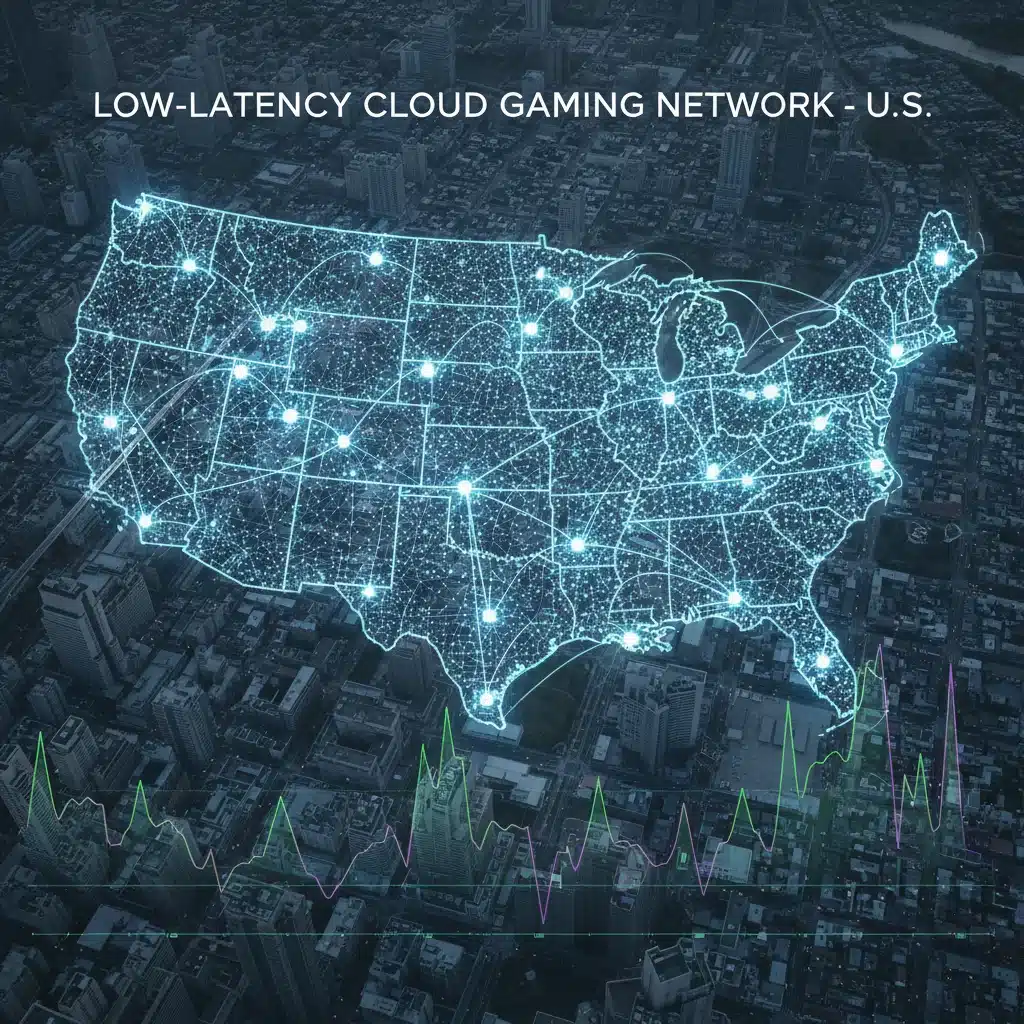
Beyond the raw computational power, the network infrastructure is equally vital for cloud gaming. Latency, the delay between a player’s action and the game’s response, is the ultimate enemy of a good cloud gaming experience. To minimise latency, data centres must be strategically distributed across the US, forming a dense network of ‘edge’ data centres closer to end-users.
This necessitates:
- Edge Computing: Moving computational resources closer to the data source (the player) reduces the round-trip time for data packets. This involves building smaller, more numerous data centres at the periphery of the network.
- High-Speed Interconnects: The fibre optic networks connecting these data centres to internet exchange points and ultimately to users must be incredibly fast and robust.
- Software-Defined Networking (SDN): Advanced networking technologies that allow for dynamic allocation and optimisation of network resources are crucial for managing the fluctuating and demanding traffic patterns of cloud gaming.
The development of this advanced network architecture represents a significant investment and logistical challenge. It’s not enough to simply build more data centres; they must be interconnected in a way that supports the ultra-low latency requirements of cloud gaming. This evolution of the Cloud Gaming Infrastructure is central to its widespread adoption and success.
Challenges and Opportunities for US Infrastructure Providers
The projected growth of cloud gaming presents both significant challenges and immense opportunities for US infrastructure providers:
Challenges:
- Capital Investment: Building and upgrading data centres to meet cloud gaming demands requires massive capital investment in hardware, real estate, and power infrastructure.
- Skilled Workforce: There’s a growing need for skilled professionals to design, build, operate, and maintain these complex facilities.
- Regulatory Hurdles: Navigating local zoning laws, environmental regulations, and power utility agreements can be complex and time-consuming.
- Supply Chain Constraints: The global demand for high-end GPUs, CPUs, and networking equipment can lead to supply chain bottlenecks, impacting expansion plans.
- Cybersecurity: Protecting these vital facilities and the vast amounts of user data they process from sophisticated cyber threats is an ongoing challenge.
Opportunities:
- Economic Growth: The expansion of data centre infrastructure creates jobs, stimulates local economies, and drives innovation in related industries.
- Technological Advancement: The demands of cloud gaming push the boundaries of data centre technology, leading to advancements in cooling, power efficiency, and network performance that benefit other sectors.
- Renewable Energy Adoption: The high energy demands can incentivise data centre operators to invest in renewable energy sources, accelerating the transition to a greener grid.
- New Business Models: The need for specialised infrastructure creates opportunities for co-location providers, network service providers, and hardware manufacturers.
- Edge Computing Innovation: The drive for lower latency will accelerate the development and deployment of edge computing solutions, with broader applications beyond gaming.
The balancing act between meeting demand and managing these challenges will define the success of Cloud Gaming Infrastructure in the US.
Mitigating the Impact: Strategies for Sustainable Growth
To ensure the sustainable growth of cloud gaming and manage its impact on US data centre demands by 2026, several strategies are crucial:
- Energy Efficiency and Optimisation:
- Advanced Cooling Technologies: Implementing liquid cooling, adiabatic cooling, and other innovative systems to reduce energy spent on temperature regulation.
- Hardware Optimisation: Utilising energy-efficient server hardware, including custom-designed chips and power management software.
- Workload Management: Dynamically allocating resources and powering down idle servers or components during off-peak hours.
- Renewable Energy Sourcing:
- Power Purchase Agreements (PPAs): Data centre operators directly contracting with renewable energy providers (solar, wind) to offset their energy consumption.
- On-site Renewable Generation: Investing in solar panels or other renewable energy sources directly at data centre locations where feasible.
- Grid Modernisation: Advocating for and investing in a smarter, more resilient national power grid capable of handling increased renewable energy integration.
- Distributed and Edge Computing:
- Strategic Placement of Data Centres: Building smaller, modular data centres closer to end-users to reduce latency and improve overall efficiency.
- Content Delivery Networks (CDNs) for Gaming: Optimising existing CDN infrastructure or developing specialised gaming CDNs to cache game assets closer to players.
- Software and Platform Optimisation:
- Efficient Game Streaming Protocols: Developing and refining algorithms that compress video streams more effectively without sacrificing visual quality or increasing latency.
- Virtualisation and Containerisation: Maximising resource utilisation by efficiently running multiple game instances on shared hardware.
- Government and Industry Collaboration:
- Policy Support: Governments can incentivise green data centre development through tax breaks, grants, and streamlined permitting processes.
- Research and Development: Funding collaborative research into next-generation data centre technologies and sustainable practices.
- Standardisation: Developing industry-wide standards for energy efficiency and environmental impact reporting.
These proactive measures are essential to ensure that the exciting future of cloud gaming does not come at an unsustainable environmental or infrastructural cost. The development of robust and eco-friendly Cloud Gaming Infrastructure is a shared responsibility.
The Future Landscape: Beyond 2026
Looking beyond 2026, the evolution of cloud gaming and its impact on US data centre infrastructure will continue at a rapid pace. We can anticipate even greater integration with emerging technologies such as:
- Artificial Intelligence (AI) and Machine Learning (ML): AI can be leveraged for dynamic resource allocation, predictive maintenance of data centre equipment, and even enhancing the gaming experience itself through AI-powered NPCs or adaptive game worlds.
- Quantum Computing: While still in its nascent stages, quantum computing could eventually revolutionise data processing, potentially offering unprecedented efficiency for complex computational tasks required by future gaming.
- Metaverse Integration: As the metaverse concept evolves, requiring persistent, highly interactive virtual worlds, the demands on data centres will multiply exponentially, making the current cloud gaming challenges seem modest by comparison. Cloud gaming will be a foundational technology for seamless metaverse experiences.
- Further Miniaturisation and Decentralisation: The trend towards smaller, more distributed computing nodes (potentially even micro-data centres in urban areas) will continue to push computing closer to the user.
The journey of Cloud Gaming Infrastructure is one of continuous innovation and adaptation. The lessons learned and investments made between now and 2026 will lay the groundwork for a far more complex and interconnected digital future.
Conclusion: A Call for Strategic Investment and Innovation
The trajectory of cloud gaming is undeniable, promising a future where high-quality interactive entertainment is accessible to everyone, everywhere. However, this vision is inextricably linked to the capacity and sustainability of US data centre infrastructure. By 2026, the demands placed upon these facilities will be immense, driven by the need for high-performance computing, ultra-low latency, and vast bandwidth.
Meeting these demands requires a strategic, multi-faceted approach. It necessitates significant capital investment in new, more efficient hardware and advanced network architectures. It demands a relentless focus on energy efficiency and a rapid transition to renewable energy sources to mitigate environmental impact. Furthermore, it calls for close collaboration between technology providers, infrastructure operators, and government bodies to foster an environment conducive to innovation and sustainable growth.
The impact of cloud gaming on US data centre demands by 2026 is more than just a technical challenge; it’s a pivotal moment in the evolution of our digital infrastructure. How we respond to this challenge will not only shape the future of entertainment but also set precedents for how we manage the energy and environmental footprint of the broader digital economy. Investing wisely in Cloud Gaming Infrastructure now will ensure a future that is both technologically advanced and environmentally responsible.