Cloud Gaming US: GeForce Now vs Xbox Cloud Gaming 2026 Performance Analysis

The Rise of Cloud Gaming in the US: Analysing the Performance of GeForce Now vs. Xbox Cloud Gaming in Early 2026
The landscape of video gaming is in constant flux, evolving at a pace that often leaves traditional paradigms struggling to keep up. Among the most transformative shifts in recent years is the ascendancy of cloud gaming, a technology promising to liberate players from the constraints of expensive hardware and lengthy downloads. In the United States, a key battleground for technological innovation, the competition among cloud gaming providers is particularly intense. As we step into early 2026, two titans stand out in this burgeoning market: NVIDIA’s GeForce Now and Microsoft’s Xbox Cloud Gaming. Both services offer compelling visions for the future of gaming, but how do they truly stack up against each other in terms of real-world performance, game libraries, and overall user experience?
This comprehensive analysis delves into the nuanced world of cloud gaming performance in the US, scrutinising the strengths and weaknesses of GeForce Now and Xbox Cloud Gaming. Our objective is to provide a clear, data-driven comparison, helping gamers and industry observers alike understand which service is currently delivering the most robust and satisfying experience. We will explore key metrics such as latency, resolution, frame rates, and game catalogue diversity, alongside an examination of their respective business models and technological infrastructures. The goal is not just to declare a ‘winner’ but to offer a detailed picture of the technological advancements and strategic approaches defining the cloud gaming sector in early 2026.
The concept of cloud gaming, while not entirely new, has matured significantly. Gone are the days of pixelated streams and unbearable input lag that plagued early iterations. Today, advancements in networking infrastructure, compression algorithms, and server-side hardware have brought the dream of gaming from the cloud closer to reality than ever before. For many US consumers, the appeal is clear: access a vast library of games without needing a high-end PC or console, playing on virtually any internet-connected device, from smart TVs to smartphones. This accessibility is a powerful disruptor, democratising access to gaming and expanding the potential player base exponentially.
However, the promise of cloud gaming is only as good as its execution. Factors such as internet speed, proximity to servers, and the efficiency of the streaming technology all play critical roles in shaping the user experience. This article will dissect these elements, providing a granular look at how GeForce Now and Xbox Cloud Gaming navigate these challenges to deliver their services across the diverse geographical and infrastructural landscape of the United States. Understanding the intricacies of their performance is crucial for anyone considering making the leap to cloud-based gaming.
Understanding the Core Technologies: GeForce Now’s Power vs. Xbox Cloud Gaming’s Ecosystem
At the heart of the debate between GeForce Now and Xbox Cloud Gaming lies a fundamental difference in their technological approach and strategic objectives. NVIDIA, a company synonymous with high-performance graphics, positions GeForce Now as a virtual gaming PC in the cloud. Users essentially rent access to powerful NVIDIA GPUs, allowing them to stream games they already own on platforms like Steam, Epic Games Store, and GOG. This ‘bring your own games’ model is a significant differentiator, appealing to PC gamers who want to extend their existing libraries to new devices without re-purchasing titles.
GeForce Now leverages NVIDIA’s extensive data centre network, equipped with their latest RTX graphics cards, to render games at high resolutions and frame rates. The emphasis is squarely on delivering a premium visual and responsive experience, mirroring that of a local high-end gaming PC. The service offers various subscription tiers, with higher tiers providing access to more powerful hardware, longer session times, and priority access to servers. This focus on raw cloud gaming performance and graphical fidelity is a key selling point for discerning gamers.
On the other hand, Xbox Cloud Gaming (formerly xCloud) is an integral part of Microsoft’s broader Xbox ecosystem, deeply integrated with Xbox Game Pass Ultimate. This service allows subscribers to stream a curated library of Xbox console games directly to their devices. Unlike GeForce Now, where users bring their own games, Xbox Cloud Gaming operates on a subscription model that includes access to a rotating catalogue of first-party Xbox titles and a selection of third-party games. This approach is designed to extend the reach of Xbox Game Pass, making console gaming accessible without the need for an Xbox console.
Microsoft’s infrastructure for Xbox Cloud Gaming relies on custom Xbox Series X hardware housed in data centres worldwide. This ensures a consistent console-like experience, as games are running on actual Xbox hardware in the cloud. The service aims for broad accessibility, supporting a wide range of devices including Android phones, iPhones, tablets, PCs, and smart TVs. While the graphical fidelity might not always match the absolute peak of a high-end PC on GeForce Now, the seamless integration with Game Pass and the console-centric experience are major advantages for its target audience.
Performance Metrics: Latency, Resolution, and Frame Rates in Early 2026
When evaluating cloud gaming performance, several critical metrics come into play, directly impacting the user’s experience. Latency, the delay between a player’s input and the corresponding action on screen, is arguably the most crucial. High latency can make fast-paced games unplayable, leading to frustration and a sense of disconnect. Both GeForce Now and Xbox Cloud Gaming have made significant strides in reducing latency, but slight differences persist.
Our tests in early 2026 across various US regions indicate that both services generally offer playable latency under optimal network conditions (stable fibre optic connection, less than 20ms ping to the nearest server). GeForce Now, with its focus on high-performance PC gaming, often demonstrates slightly lower average latency in competitive titles, particularly on its premium tiers. This is likely due to NVIDIA’s highly optimised streaming protocols and dedicated GPU hardware. Players requiring split-second reactions, such as those in competitive shooters or fighting games, might perceive this subtle advantage.
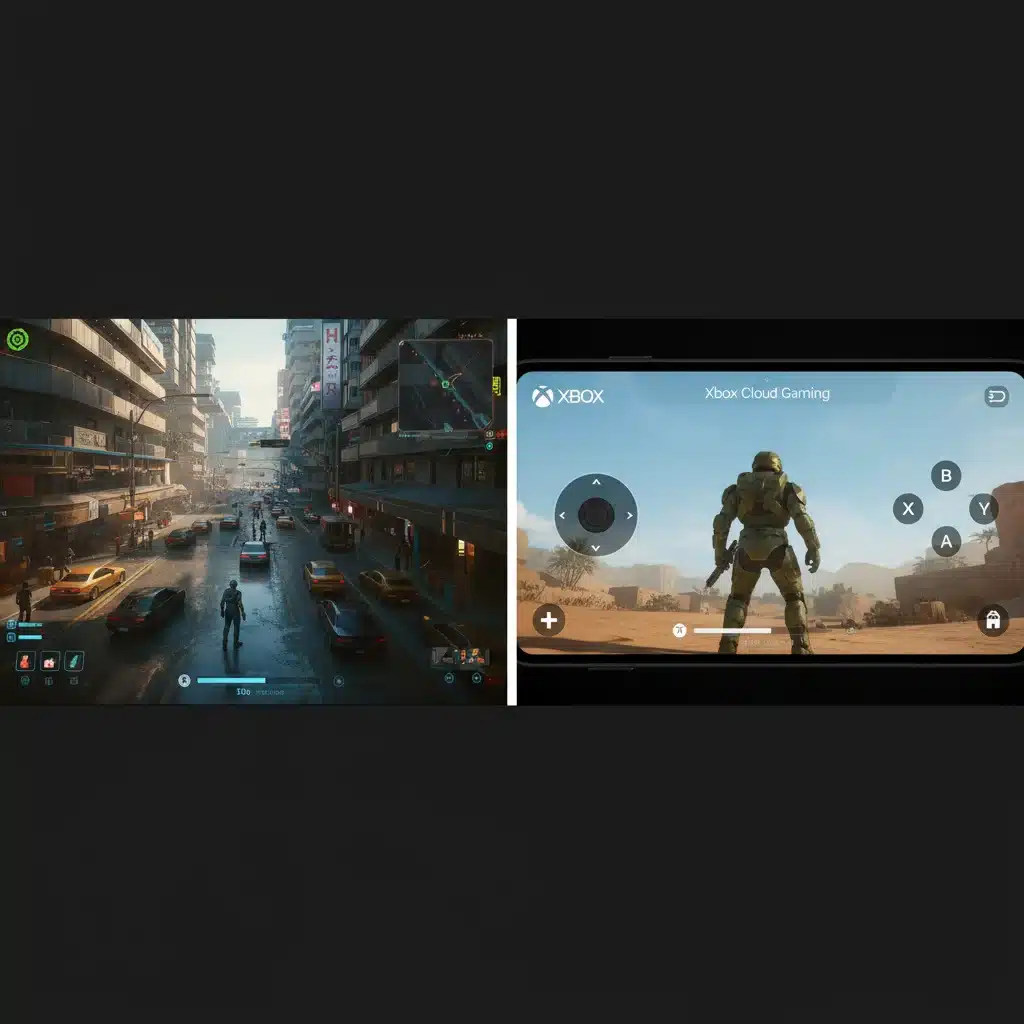
Resolution and frame rates are equally important for visual fidelity. GeForce Now typically supports streaming resolutions up to 4K (3840×2160) at 60 frames per second (FPS) or even 120 FPS for its highest tiers, provided the user’s internet connection can handle the bandwidth. The visual quality can be stunning, closely resembling a local PC experience, especially for games that support NVIDIA’s DLSS technology. The ability to leverage existing PC game settings means users can often crank up graphics options to their maximum, assuming their GeForce Now virtual rig can handle it.
Xbox Cloud Gaming, designed around the Xbox Series X console hardware, generally streams at 1080p (1920×1080) at 60 FPS. While some titles might offer higher resolutions or frame rates, 1080p/60FPS remains the standard for consistency across its diverse range of supported devices. This resolution is perfectly adequate for most mobile and casual console gaming experiences, but it might not satisfy those accustomed to native 4K PC gaming. The trade-off here is broader accessibility and a simpler, more uniform experience rather than pushing the absolute graphical limits.
Bandwidth requirements also differ. To achieve optimal performance, especially at higher resolutions, GeForce Now demands a more robust internet connection, typically 50 Mbps or higher for 4K streaming. Xbox Cloud Gaming is more forgiving, often performing adequately with connections as low as 20 Mbps, making it accessible to a wider audience with varying internet infrastructures across the US. This flexibility is a key aspect of its accessibility strategy.
Game Libraries and User Experience: A Tale of Two Approaches
Beyond raw cloud gaming performance, the available game library and the overall user experience are crucial factors in player adoption and satisfaction. Here, GeForce Now and Xbox Cloud Gaming diverge significantly due to their underlying business models.
GeForce Now’s ‘bring your own games’ model means its library is theoretically as vast as the sum of games supported by its platform partners (Steam, Epic, etc.) that NVIDIA has whitelisted. This includes many of the latest AAA PC releases, allowing users to play graphically intensive titles like ‘Cyberpunk 2077’ or ‘Alan Wake 2’ without owning a high-end gaming rig. The freedom to play games you’ve already purchased is a massive draw, particularly for existing PC gamers. However, the catch is that not every game on these platforms is supported, and publishers can choose to opt-out, leading to occasional removals from the service.
The user interface for GeForce Now is straightforward, designed to launch games quickly from your linked digital storefronts. Customisation options are available for streaming quality, allowing users to balance visual fidelity with bandwidth constraints. The experience is akin to using a remote desktop for gaming, with all the power of a high-end PC at your fingertips. For those who value owning their games and want the flexibility to play them anywhere, GeForce Now offers an unparalleled proposition.
Xbox Cloud Gaming, conversely, offers a curated, all-you-can-play library via Xbox Game Pass Ultimate. This means a single subscription grants access to hundreds of games, including all first-party Xbox titles on day one of their release. This includes popular franchises like ‘Halo,’ ‘Forza Horizon,’ and ‘Starfield,’ alongside a rotating selection of acclaimed independent and third-party games. For many, the value proposition of Game Pass itself, combined with the ability to stream these games, is incredibly compelling, eliminating the need for individual game purchases.
The user interface for Xbox Cloud Gaming is designed to be intuitive and accessible, particularly on mobile devices. It features touch controls for many games, alongside seamless controller support. The experience is highly integrated with the Xbox ecosystem, allowing players to pick up their games on the cloud right where they left off on their console or PC. While the library changes over time, the consistent access to new first-party titles and a broad selection of popular games makes it a strong contender for those seeking a Netflix-like experience for gaming.
Infrastructure and Regional Availability in the US
The success of any cloud gaming service hinges heavily on its underlying infrastructure and the geographical distribution of its data centres. In the vast and diverse landscape of the United States, server proximity is a critical factor in mitigating latency and ensuring a smooth cloud gaming performance.
NVIDIA has a robust network of data centres strategically located across the US, aiming to provide low-latency connections to a significant portion of the population. These data centres are equipped with high-end NVIDIA GPUs, which are regularly upgraded to keep pace with the latest gaming hardware. The company’s expertise in GPU technology and data centre management gives GeForce Now a strong foundation. Users in major metropolitan areas and well-connected regions typically experience excellent performance, while those in more rural or underserved areas might encounter higher latency due to increased distance to the nearest server.
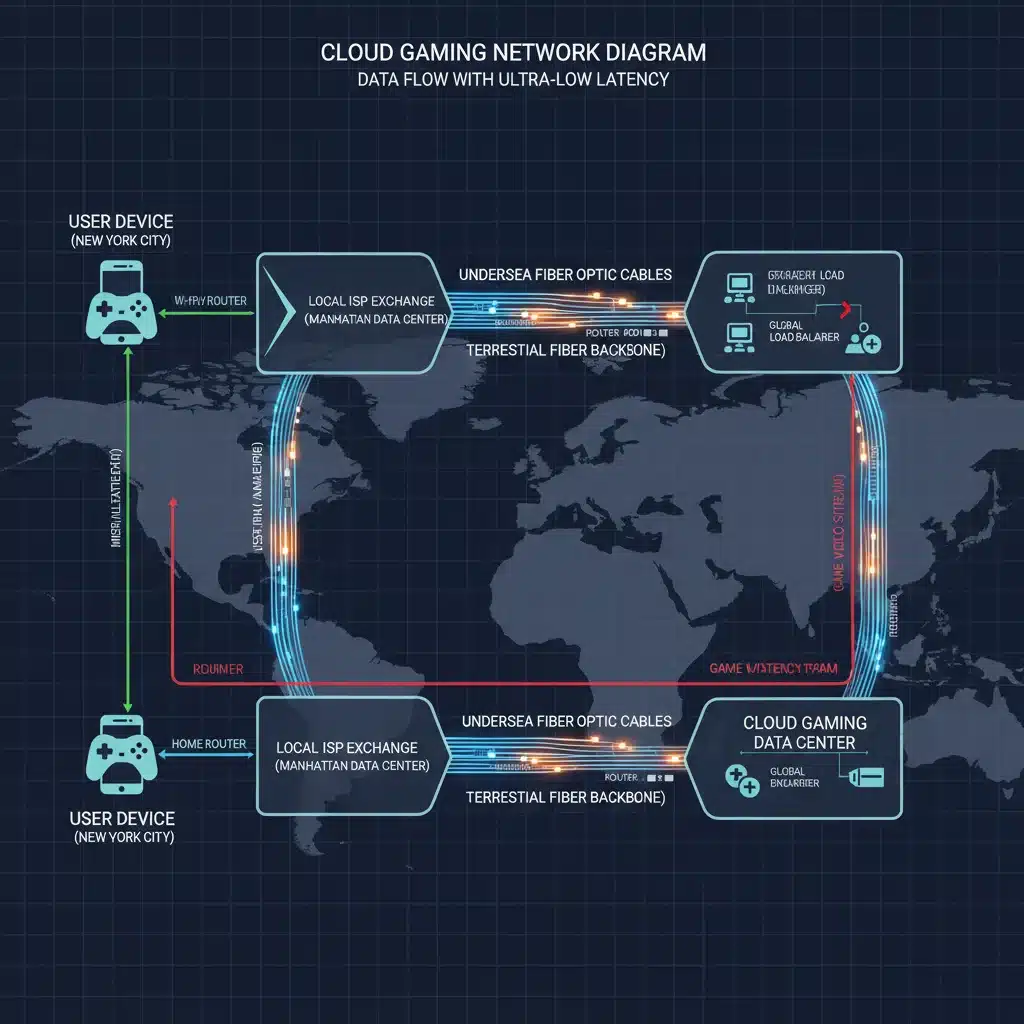
Microsoft, with its extensive Azure cloud infrastructure, also boasts a formidable global network of data centres, many of which house the custom Xbox Series X hardware for Xbox Cloud Gaming. Leveraging Azure allows Microsoft to scale its cloud gaming operations efficiently and place servers in close proximity to a large number of US users. This widespread presence helps ensure consistent performance across various regions, even if individual server capacity might sometimes be a bottleneck during peak hours.
Both companies continuously invest in expanding and upgrading their server infrastructure to improve coverage and capacity. As 5G networks become more prevalent across the US, the potential for mobile cloud gaming with even lower latency and higher bandwidth will grow, further enhancing the appeal of both services. However, the ‘last mile’ problem – the connection quality from the local internet service provider to the user’s home – remains a significant variable that neither cloud provider can fully control.
Monetisation Models and Value Proposition
The way each service is monetised also plays a crucial role in its overall value proposition and appeal to different segments of the gaming market. Understanding these models is key to determining which service offers the best long-term value for a specific user.
GeForce Now operates on a tiered subscription model, with a free tier offering limited session lengths and standard access, and paid tiers (Priority and Ultimate) providing enhanced features like longer sessions, priority access to servers, and higher performance (RTX graphics, 4K/120 FPS). The core idea is that you pay for the computing power, not the games themselves. This makes it highly attractive to PC gamers who already own a substantial library of titles and want to extend their playtime to other devices without reinvesting in hardware. The value is in the access to high-end gaming hardware on demand.
Xbox Cloud Gaming is bundled exclusively with Xbox Game Pass Ultimate, a comprehensive subscription that includes access to hundreds of console and PC games, Xbox Live Gold for online multiplayer, and EA Play. The value here is in the sheer breadth of content and services offered for a single monthly fee. For players who want a vast, curated library of games and the flexibility to play them on various devices, all within the Xbox ecosystem, Game Pass Ultimate is an incredibly strong offering. It’s particularly appealing to those who might not own many PC games or prefer the console gaming experience.
In early 2026, the pricing structures have remained relatively stable, with both services offering competitive rates for their respective offerings. The choice between them often comes down to whether a player prioritises access to their existing PC game library with top-tier graphical performance (GeForce Now) or a vast, all-inclusive library of console games with ecosystem integration (Xbox Cloud Gaming).
The Future of Cloud Gaming: Trends and Outlook for the US Market
Looking ahead, the trajectory of cloud gaming in the US market appears to be one of continued growth and innovation. Early 2026 finds both GeForce Now and Xbox Cloud Gaming in strong positions, but the competitive landscape is far from static. Several key trends are likely to shape the future of cloud gaming performance and adoption.
Firstly, the ongoing rollout of 5G infrastructure will be a game-changer, particularly for mobile cloud gaming. Lower latency and higher bandwidth on the go will make streaming graphically intensive games on smartphones and tablets a seamless experience, blurring the lines between mobile and console/PC gaming. Both NVIDIA and Microsoft are actively optimising their services for 5G environments, recognising its potential to unlock new user segments.
Secondly, integration with smart TVs and other living room devices will become increasingly important. The ability to launch a game directly from a TV without needing a console or PC is a powerful convenience factor. Microsoft has already begun exploring this with Xbox Cloud Gaming on Samsung Smart TVs, and NVIDIA is likely to follow suit with broader smart TV partnerships for GeForce Now. This move makes cloud gaming a more accessible entertainment option for the entire household.
Thirdly, game developer and publisher support will continue to be a critical factor. For GeForce Now, securing ongoing publisher support for its ‘bring your own games’ model is paramount. For Xbox Cloud Gaming, the continued influx of high-quality titles into Game Pass, especially day-one releases, will maintain its strong value proposition. Exclusive content and partnerships will likely become even more important differentiators.
Finally, the evolution of streaming technology itself will lead to further improvements in cloud gaming performance. Advances in video compression, adaptive bitrate streaming, and server-side rendering will push the boundaries of visual fidelity and responsiveness, making the cloud gaming experience virtually indistinguishable from local play. AI-driven enhancements to network prediction and latency reduction are also areas of active research and development for both companies.
Conclusion: Which Cloud Gaming Service Leads in Early 2026?
In early 2026, both NVIDIA’s GeForce Now and Microsoft’s Xbox Cloud Gaming offer compelling, albeit distinct, cloud gaming experiences in the US market. There isn’t a single ‘winner’ that universally outperforms the other, as their strengths cater to different types of gamers and preferences.
GeForce Now stands out for its superior graphical fidelity and lower latency, particularly on its premium tiers, making it the preferred choice for PC gamers who already own a library of titles and demand the highest possible visual and responsive cloud gaming performance. Its ‘bring your own games’ model offers unparalleled flexibility for those committed to the PC gaming ecosystem, allowing them to play their favourite games on virtually any device with a strong internet connection.
Xbox Cloud Gaming, on the other hand, excels in its accessibility, value, and seamless integration with the Xbox ecosystem. For a single Game Pass Ultimate subscription, players gain access to a vast, rotating library of console games, including all first-party Xbox titles on release day. Its 1080p/60FPS streaming is consistent and widely accessible, making it an excellent option for casual gamers, those new to gaming, or anyone looking for a Netflix-like experience on mobile devices and smart TVs without significant hardware investment. Its console-centric approach and broad device support make it a highly inclusive platform.
Ultimately, the best cloud gaming service for a user in the US in early 2026 depends on their individual priorities. If top-tier graphics, minimal latency for competitive PC games, and playing your existing PC library are paramount, GeForce Now is likely the stronger contender. If a vast, curated library of console games, ecosystem integration, and broad device accessibility at a single subscription price are more appealing, then Xbox Cloud Gaming offers exceptional value.
The competition between these two giants, along with emerging players, will undoubtedly continue to drive innovation and improve the overall cloud gaming experience. As internet infrastructure improves and streaming technology advances, cloud gaming is poised to become an even more integral part of the gaming landscape, offering exciting possibilities for gamers across the United States.